Artemis II beamed 4K video from the Moon over a laser. The backup station was a $5M Australian kit.
NASA's Orion O2O terminal hit 260 Mbps from lunar orbit to White Sands, Table Mountain, and a sub-$5M Australian station. Crewed lasercom cleared its first real test.
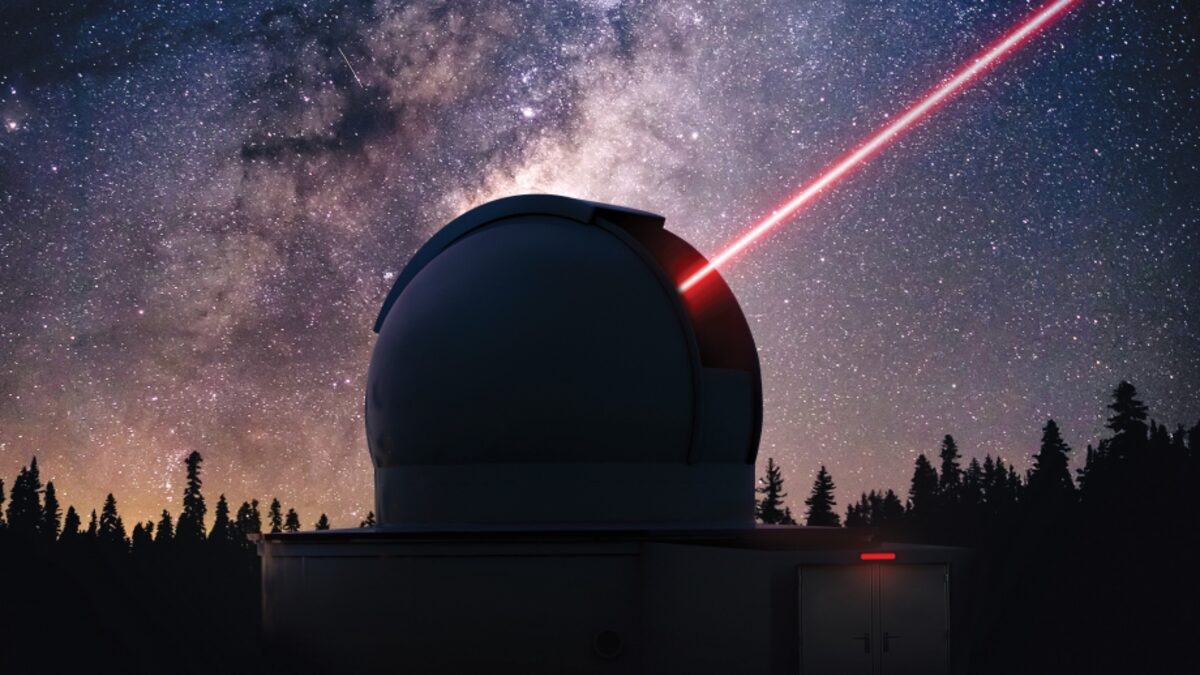
Artemis II launched April 1 with a laser communications terminal strapped to the Orion service module and a very specific question attached: can you stream a crewed mission’s data back from lunar distance on a beam of light? The answer, as of the first round of downlinks: yes, at 260 megabits per second, including 4K video, on multiple ground stations including one built for under $5 million.
The O2O terminal, and why it’s on this flight
The Orion Artemis II Optical Communications System (O2O) was developed at MIT Lincoln Laboratory in partnership with NASA Goddard. The pitch for lasercom over radio has been the same for two decades: a tighter beam means more bits per watt, and the bandwidth ceiling is orders of magnitude higher than radio can reach at the same spacecraft power budget. What’s been missing is the operational proof in a crewed lunar flight, with all the human-rated reliability that implies.
Artemis II is that proof. The crew (Reid Wiseman, Victor Glover, Christina Koch, Jeremy Hansen) are the first humans to demonstrate lasercom during a lunar mission. O2O is hitting peak rates of 260 Mbps from the Moon’s vicinity, which is the kind of bandwidth you need if you want to relay not just mission-critical telemetry but high-definition video from the cabin back to the Deep Space Network.
The Australian terminal matters more than the headline bandwidth
The headline rate is impressive, but the interesting engineering story is on the receiving side. NASA’s primary ground stations for the demo are White Sands Missile Range in New Mexico and Table Mountain in California, both high-altitude dry-atmosphere sites with a long history of optical receiver work.
The third station is new. NASA partnered with the Australian National University to pull down the same Orion signal at Mount Stromlo Observatory. TechCrunch reported the Australian terminal was built by Observable Space (telescope + software) and Quantum Opus (photonic sensor), and the total hardware bill came in under $5 million, versus tens of millions for a bespoke NASA-class receiver. The Australian kit matched the 260 Mbps link.
That’s the number worth pausing on. If you can receive a lunar laser downlink on a commercial-grade, $5M ground station, lasercom stops being an exotic NASA-only capability and starts being a procurable piece of infrastructure. Universities can build one. Agencies can build a dozen. Private lunar operators (Intuitive Machines, ispace, the coming wave of crewed commercial lunar plans) have a viable comms tier that doesn’t require booking Deep Space Network time.
The implications beyond this mission
NASA has been building toward this for a decade. The LCRD relay in GEO and LCRD’s follow-on experiments established the waveforms and the pointing control. Artemis II is the integration test: same physics, crewed mission, operating distance.
If future Artemis missions (including the lunar surface landing in Artemis III) adopt lasercom as the primary high-rate link, it changes what instruments are worth flying. Today, you design experiments around the data ceiling radio will give you. Tomorrow, you design them around how much science you can cram into a 260-Mbps or faster pipe. For contextual contrast, Apollo-era radio returns ran at hundreds of kilobits per second. That’s a 1000x improvement in what you can bring home.
Mars is next. Deep-space optical links have to contend with nuisance scale: the same beam has to be orders of magnitude tighter to not spread into unusable flux. NASA’s already running the Psyche DSOC experiment as a precursor. Artemis II proving the crewed side at lunar range is a big step toward trusting the stack enough to depend on it at Mars range.
What this means for you
If you work on space systems or care about how much science and video returns from crewed flights, the specific bit of news is that laser relays now work in a human-rated context and can be received on sensibly priced ground hardware. That’s a mission-design change. Budgets and experiment plans for every future lunar mission should be asking what the uplink ceiling and downlink ceiling look like under lasercom instead of radio.
If you don’t work on space systems, the Artemis II demonstration is still the clearest example in recent memory of what public R&D money does well. Two decades of Lincoln Lab optical work, an Australian academic partnership, and a commercial terminal that slots in alongside NASA’s bespoke receivers, all arriving at the same mission at the same time. That’s the stuff that doesn’t come back as a quarterly earnings line, but it’s what expands what future generations will get to do off the planet. Watch the Artemis III timeline carefully: whether NASA commits to lasercom as a primary link for the lunar surface landing will tell you how much confidence today’s first 260 Mbps actually earned.
Share this article
Sources
- NASA's Artemis II moon mission shows space-to-Earth laser comms can scale — TechCrunch
- Lincoln Laboratory laser communications terminal launches on historic Artemis II moon mission — MIT News
- NASA, Australia Team Up for Artemis II Lunar Laser Communications Test — NASA
- NASA's Artemis II laser communications system is beaming 4K video from the moon — Scientific American