A 2,000-year-old scroll was read end to end. No one ever unrolled it.
The Vesuvius Challenge read a whole carbonized Herculaneum scroll using CT scans and machine learning. Here is how the ink-detection pipeline works.
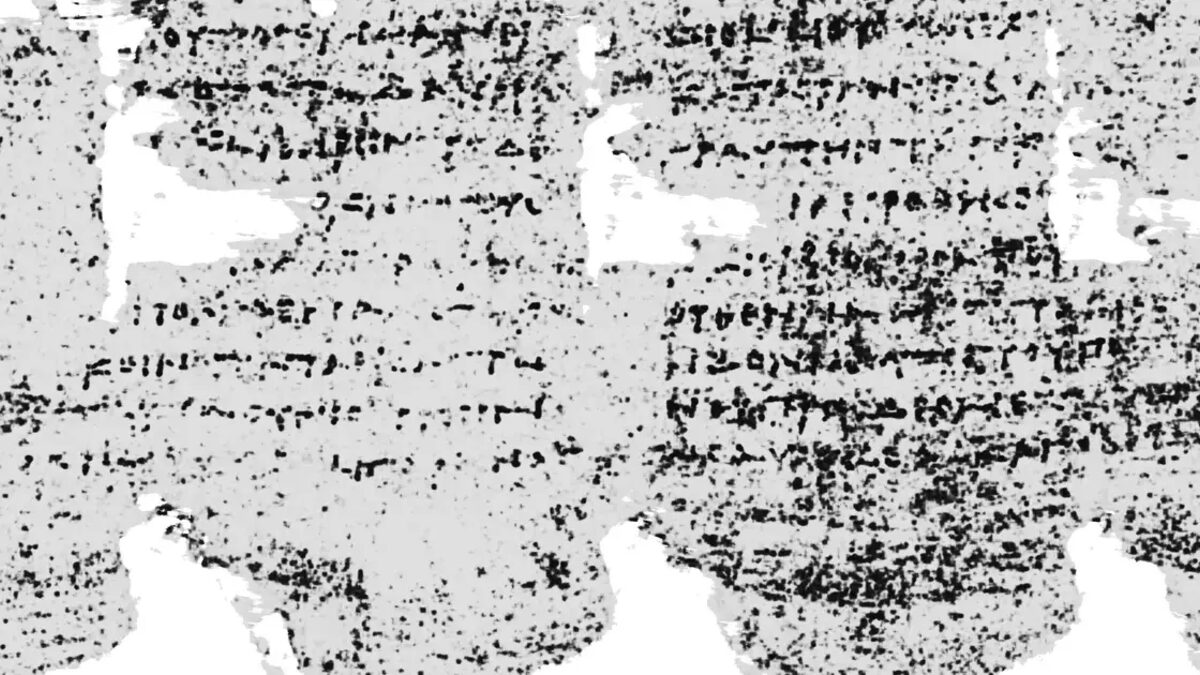
A scroll no human has opened in nearly 2,000 years has now been read cover to cover. On June 25, the Vesuvius Challenge said its team read an entire Herculaneum papyrus end to end, a first for these scrolls, with nobody unrolling it. The scroll, PHerc. 1667, was carbonized by Mount Vesuvius in 79 AD.
What makes this a machine-learning story, and not just an archaeology one, is the method. Nobody touched the page. The whole reading came out of an X-ray scan and a stack of models that learned to see ink a human eye slides right past. The Challenge has now read roughly 20 columns of Greek out of a scroll that was, until a few weeks ago, completely illegible. You can’t open the book, so you scan it and teach software to read through the layers.
Why the scrolls stayed shut
The Herculaneum scrolls are the only library to survive intact from the ancient world, and that is precisely why they were unreadable. When Vesuvius buried the seaside town in 79 AD, the heat did not burn the scrolls to ash. It carbonized them, turning each rolled papyrus into a fragile black cylinder. Try to unroll one by hand and it crumbles. Early attempts in the 1700s and 1800s destroyed a number of them outright. They weren’t being careless; there just wasn’t a method that didn’t shred the page.
So the scrolls sat in collections in Naples, Paris, and Oxford for two centuries, physically preserved but, as University of Kentucky professor Brent Seales put it, “intellectually inaccessible.” The text was right there. Reading it meant opening a book made of charcoal.
Seales spent years arguing the answer wasn’t a better pair of tweezers. It was a scanner and an algorithm. His EduceLab group at Kentucky showed that machine learning could pick out ink in the X-ray data of a charred scroll, which set up everything that followed.
How the pipeline works
The method is called virtual unwrapping, and it runs in four steps. None of them involve a scalpel.
First, the scan. The scroll goes into a particle accelerator, a synchrotron, where high-resolution X-ray microtomography images it from every angle. The Diamond Light Source in the UK and the ESRF in France have both done this work. A single scroll produces a 3D scan that can run up to 300 terabytes of data, a volumetric picture of every wrap of papyrus packed inside.
Second, segmentation. The papyrus is rolled into dozens of tightly packed layers that touch and merge in the scan. Software, with a lot of human correction, traces each layer through the 3D volume so it can be peeled apart digitally. This is the slow, painful part, the equivalent of following one sheet of a soaked newspaper through the whole wad without tearing into the page above it.
Third, flattening. Once a layer is traced, it gets unrolled into a flat 2D image, the way the scribe would have seen the page before it was rolled up.
Fourth, ink detection, and this is where machine learning earns its keep. The ink on these scrolls is carbon-based, sitting on a substrate that is now also carbon. In the raw scan, inked papyrus and blank papyrus look nearly identical. A model is trained on patches where the ink location is already known, then learns the faint textural signature that separates a written stroke from bare fiber. Run it across a flattened layer and the letters surface. A human reader genuinely cannot do this by eye in most cases. The signal is too subtle.
The result isn’t a clean printout. It’s a grayscale image where Greek letters fade in and out, and papyrologists then transcribe what the model surfaces. Every reading gets checked by hand, because a model that’s hunting for faint patterns will happily invent one if you let it.
A fair question: how do they know the letters are real and not the model dreaming up shapes in noise? The answer is cross-checking. One of the scrolls confirmed in this announcement, PHerc. Paris 4, now shows its ink directly in the high-resolution scan, and that reading matches the 2023 prize-winning result one to one. When two independent passes land on the same letters, that’s strong evidence the pipeline is recovering writing rather than hallucinating it.
From one word to a whole scroll
This didn’t happen overnight. The Vesuvius Challenge launched in 2023, co-founded by Seales with tech investors Nat Friedman and Daniel Gross, with prize money put up to crowdsource the hard parts of the pipeline. The bet was that open data plus cash bounties would pull in talent a single lab couldn’t.
It worked fast. In October 2023, a student named Luke Farritor trained a model that surfaced the first word from inside a sealed scroll. The word was πορφύρας, Greek for “purple.” A few months later, the Challenge awarded its $700,000 Grand Prize to Farritor, Youssef Nader, and Julian Schilliger for reading several passages totaling thousands of characters, roughly 5% of one scroll.
That was passages. A few legible windows in one scroll. This is the whole thing, start to finish. The team also confirmed two more results in the same announcement: a scroll whose ink is now visible directly in the 3D scan, and another, PHerc. 139, where they recovered the title and author and identified it as a work by the philosopher Philodemus. Reading a title page might sound minor, but knowing what a scroll is lets scholars decide which ones to prioritize next. The prize pool has grown to about $1.8 million awarded so far, and most of the current research team started out as contestants.
The PHerc. 1667 text itself is a philosophical treatise on ethics. It name-checks Aristocreon, a nephew of the Stoic philosopher Chrysippus, which dates the work to the second or third century BC and makes it among the oldest scrolls unwrapped yet. One translated line reads: “we will inquire into something, but we will not grasp it, if in some way we depart from ourselves and from our own nature.” Two thousand years in the dark, and the first full sentence back is about the limits of knowledge.
What this means for you
If you’ve watched applied ML drift toward generating plausible-looking text, this is the opposite and worth holding onto: a model trained to find a signal that was genuinely there and genuinely invisible, with every output checked against a physical object by a human expert. That’s the shape of the problem ML is actually good at. There’s no hallucination budget when a papyrologist reads the letters back.
The harder part starts now. More than 600 sealed scrolls remain, and large parts of the Herculaneum villa have never been dug up. The pipeline is built to scale, but segmentation is still slow and synchrotron time is scarce. Watch the throughput, not the headline. If the team can go from one scroll to dozens without a year of hand-correction each, an entire lost library comes back, and the rate-limiting step stops being the machines and becomes the number of people alive who can read ancient Greek. As Seales said, “now we need experts who can read, edit and understand what they are saying.”
Share this article
Quick reference
Sources
- We've read an entire Herculaneum scroll — Vesuvius Challenge
- The day the Herculaneum scrolls began speaking again — University of Kentucky
- Complete text of carbonised Herculaneum scroll unlocked for first time — The Washington Post
- Vesuvius Challenge 2023 Grand Prize awarded: we can read the scrolls! — Vesuvius Challenge
Frequently Asked
- Why can't they just unroll the scrolls physically?
- The scrolls were carbonized by the heat of the 79 AD eruption. They are now brittle lumps of carbon, and physical unrolling shatters them. Virtual unwrapping reads them without touching the page.
- How does the machine learning actually find the writing?
- A model is trained on examples where ink location is known, then learns the faint textural difference between inked and blank papyrus in the CT data. The ink sits almost flush with the carbon, so a human eye usually misses it.
- What does the scroll say?
- About 20 columns of Greek philosophical text on ethics, with a reference to Aristocreon that points to a Stoic work from the second or third century BC. Papyrologists are still transcribing and interpreting it.
- How many scrolls are left?
- More than 600 sealed scrolls survive from the Herculaneum library, and large parts of the villa where they were found have not been excavated yet.