Microsoft open-sourced the earliest known DOS code, transcribed from a stack of Tim Paterson's printouts.
MIT-licensed at GitHub on April 28, the 86-DOS 1.00 kernel and PC-DOS development snapshots were OCR'd from 45-year-old assembler listings.
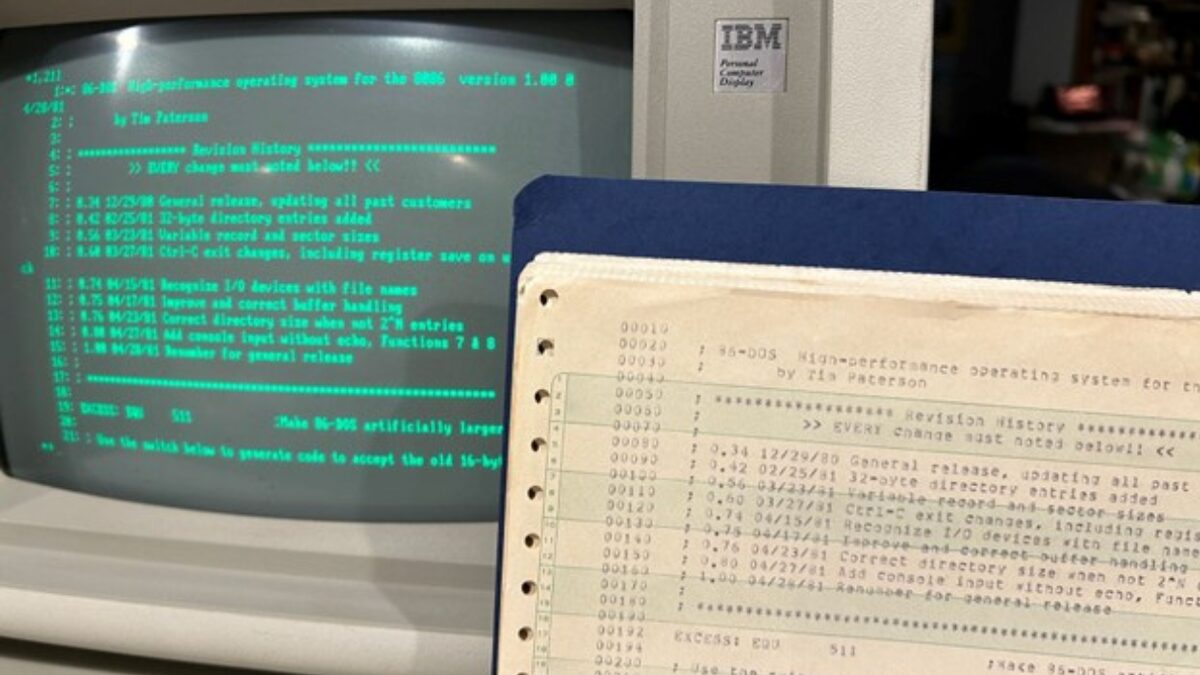
Microsoft open-sourced the earliest known DOS source code on April 28, 45 years to the day after 86-DOS 1.00 first shipped. The release lives at DOS-History/Paterson-Listings on GitHub under the MIT license. It’s the kernel of the OS that became MS-DOS, OCR’d from a stack of printed assembler listings that Tim Paterson kept in his garage for four decades.
The story of how it got there is more interesting than the code itself. Microsoft didn’t have these files. The original electronic copies were lost long before the company started caring about its own history. What survived is a set of physical printouts Paterson made while he was working on the kernel at Seattle Computer Products in 1980, with handwritten margin notes capturing the changes between iterations. Microsoft’s software historians and a community of preservationists scanned the printouts, transcribed the assembler line by line, and reconstructed a working source tree from the stack of paper.
What’s in the repo
The release covers more than just 86-DOS 1.00. It includes the kernel, several PC-DOS 1.00 pre-release snapshots, and utilities like CHKDSK. Microsoft frames the listings as documentary preservation rather than a runnable OS:
“Think of them as a printed commit history of a Git repository,” the Microsoft Open Source Blog wrote.
That framing is the right one. You won’t make this codebase and boot a VM. The files are the content of those listings rendered as text. What you can do is read the actual development history of one of the most consequential operating systems ever shipped, with the same diff-by-diff resolution you’d get from any modern Git repo, except that the diffs are visible in the form of crossed-out instructions and pencilled corrections in the margins. The original scans, including handwriting, are mirrored on the Internet Archive.
Microsoft credits Yufeng Gao and Rich Cini as the historians who carried the project, with a contributor named Joshua doing OCR research. The legal cleanup, which is the part that actually unlocked the publish, was Microsoft’s. Paterson held some rights, Microsoft held others, and the MIT license is the negotiated outcome that lets anyone use, fork, or republish without further permission.
How this compares to past DOS releases
Microsoft has done DOS open-source releases before, but each previous one was a later build:
- 2018: MS-DOS 1.25 and 2.11. Released to GitHub at the request of the Computer History Museum. These were already the polished post-PC-DOS-1.00 versions, after IBM had stamped its requirements onto the codebase.
- 2024: MS-DOS 4.0. A more substantial release of a much later kernel, including the FAT16 work that defined the DOS storage model for the next decade.
- 2026 (this release): 86-DOS 1.00 and PC-DOS 1.00 snapshots. The earliest material yet, predating MS-DOS as a brand. This is the code Microsoft bought from Seattle Computer Products for $75,000 in 1981 and rebadged for the original IBM PC.
For anyone studying how an OS gets built under acquisition pressure, the new listings fill in the part the 2024 release skipped. PC-DOS 1.00 is where the IBM-Microsoft handoff happened, and the snapshots show the in-flight changes. Microsoft says the new release “provides an even earlier look into the development of PC-DOS 1.00.”
Why it matters more than nostalgia
The retrocomputing crowd will treat this as a love letter, and that’s a fair reading. But the engineering value is real. There’s a generation of developers who have never seen a real-mode 8086 kernel and don’t know what context-switching costs in bytes when you have 64K of RAM and no MMU. The listings are a textbook for that mental model. The code is also a primary source for software-history research that has historically had to triangulate from disassembled binaries and oral interviews with the original engineers.
It’s also a quiet credibility win for Microsoft’s open-source posture. The company has been steadily expanding what it ships under permissive licenses, from .NET to TypeScript to VS Code’s core. Reaching back 45 years to publish the kernel that paid for the company’s first office is the kind of move that earns trust the marketing copy can’t.
What this means for you
If you’re a systems programmer, clone the repo this weekend. The whole tree is small enough to read in an afternoon. The interesting parts are the boot sector, the FAT12 implementation, and the BIOS interrupt handling, all in less code than a single React component.
If you’re an open-source maintainer who’s nervous about source-history liability, this is the model. Microsoft scrubbed the rights, picked a permissive license, and kept the historians named in the credits. That’s a publishable template for any company sitting on early-90s code that nobody knows what to do with.
If you’re a teacher of computer architecture, this is the assigned reading you’ve been wanting. Real production code, small enough to grasp end-to-end, that ships in a license your university’s IP office won’t object to. There’s no other 45-year-old kernel that fits all three boxes.
Share this article
Sources
- Continuing the story of early DOS development — Microsoft Open Source Blog
- DOS-History/Paterson-Listings — GitHub
- Microsoft open-sources 'the earliest DOS source code discovered to date' — Ars Technica
- Tim Paterson's DOS Listings on Internet Archive — Internet Archive