Google said people love AI search. DuckDuckGo's installs jumped 30% the next week.
DuckDuckGo's US downloads climbed about 30% and its no-AI search page saw 28% more visits the week after Google's I/O push. The backlash is now measurable.
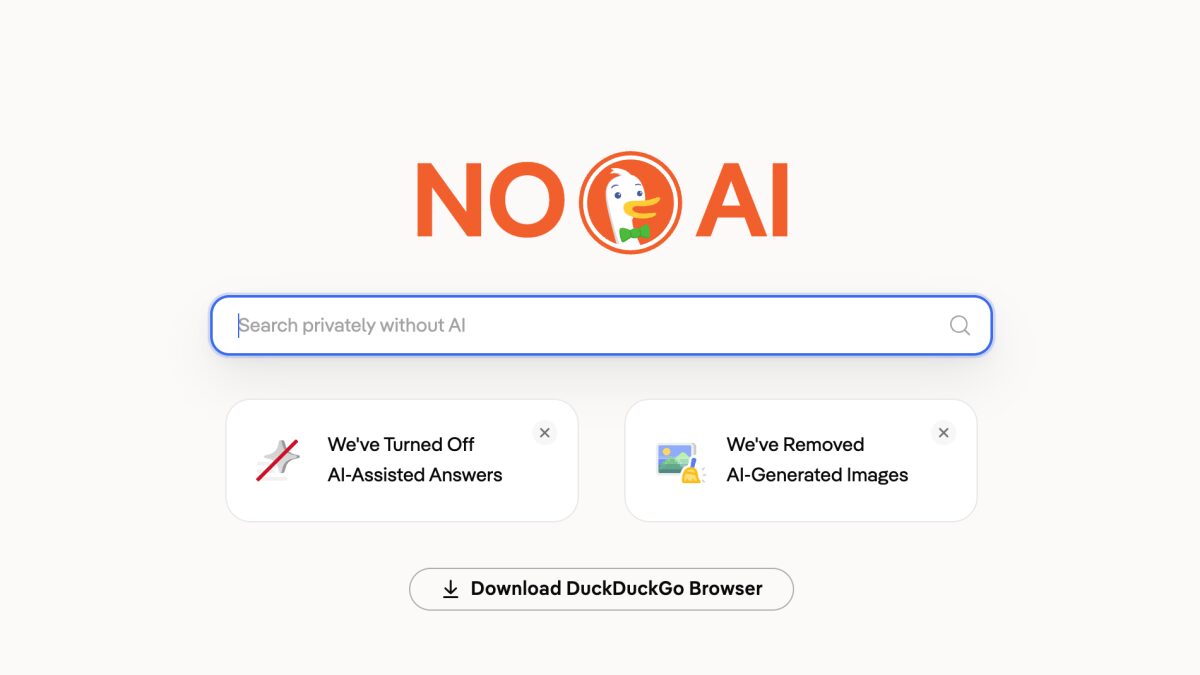
DuckDuckGo’s US app installs jumped about 30% in a single week, and the timing is hard to ignore. The spike landed right after Google used its I/O stage to lean harder into AI search and insist users love it.
The numbers come from two independent reads. App-intelligence firm Apptopia measured a 29% increase in average daily US downloads, and DuckDuckGo’s own data showed iOS installs running about 33% higher week over week, peaking near 70% on May 25. More telling than the install count: visits to the company’s AI-free search page climbed nearly 28% over the same stretch. People weren’t just downloading an app. They were going out of their way to find search without the AI layer.
What Google did at I/O
Google spent its developer keynote reframing Search as an AI product. The pitch: a conversational engine that handles longer questions, AI Overviews that answer directly above the blue links, and AI Mode that lets you ask follow-ups inside the result. AI Overviews aren’t new, they’ve shipped for about two years. What changed this month was the framing. Google’s message was that this is the direction, people like it, and there’s no real off switch.
That last part is the friction. AI Overviews appear on a large share of queries with no clean global toggle to turn them off. When a company tells you its users love a feature you can’t disable, some of those users go looking for the door. The install data suggests a chunk of them found it.
DuckDuckGo CEO Gabriel Weinberg made the contrast the whole sales pitch. “Google is force-feeding AI with no way to opt out,” he said, arguing “their results are getting worse, not better.” His framing is self-serving, he runs the competitor. But the install curve gives the claim some weight it didn’t have a week earlier.
Why a 30% spike isn’t a coup
Let’s keep the scale honest. DuckDuckGo sits in the low single digits of global search share. Google still handles the overwhelming majority of the world’s queries. A 30% week-over-week install bump off a small base is a spike, not a takeover, and weekly app-download numbers are noisy by nature. One viral news cycle can move them.
So why does this one matter? Because the AI-free page is the tell. Downloading an app can be impulse or curiosity. Navigating to noai.duckduckgo.com is a deliberate act by someone who already knows what they want and what they’re avoiding. A 28% rise there is a cleaner read on intent than the raw install figure. It says a measurable group of people actively want their search results without a generated summary sitting on top.
DuckDuckGo is leaning into that. The company offers the no-AI page with AI features off by default, and a separate Duck.ai chat product for people who do want a model, with access to options like Claude 4.5 Haiku and Llama 4 Scout. The positioning is “your choice, your privacy,” and chief communications officer Kamyl Bazbaz reduced it to four words: “People just want a choice.”
It’s a sharp piece of timing as much as product. DuckDuckGo didn’t ship anything new this month. It just stood still while Google moved, and being the thing that didn’t change turned into the pitch. That only works because the no-AI page already existed and was waiting. The company spent years building an option almost nobody asked for, and then the market handed it a week where that option was suddenly the headline.
Who this actually reaches
The risk for Google isn’t that DuckDuckGo wins. It’s that “AI-free” becomes a product category with real pull. Privacy-forward browsers, Kagi’s paid search, and the small pile of extensions that strip AI Overviews out of Google results all aim at the same frustrated user. Each one is tiny on its own. Together they describe a segment that didn’t have a name a year ago.
There’s a precedent worth watching. Every time a dominant platform removes an opt-out, a niche competitor gets a windfall of motivated switchers. It happened with ad-heavy feeds and with forced account logins. The pattern here looks identical: the people who leave first are the most engaged and the most vocal, which is exactly the cohort that seeds word-of-mouth.
The cohort matters more than its size. Power users file the bug reports, write the browser extensions, and post the &udm=14 workaround that a hundred thousand casual users then copy. Google’s own search-quality reputation rests heavily on whether the people who care most about results trust them. Lose that group and the rot shows up in sentiment long before it shows up in market share. A few hundred thousand annoyed switchers won’t dent revenue this quarter. What they can dent is the assumption that Google Search is the obvious, frictionless default, and that assumption is the entire moat.
If you’ve followed how platform defaults shape behavior, this rhymes with the fight over who gets to be the default on your devices and the broader push to bring more AI surface into everyday tools. It also sits next to the debate over who controls trust on the web itself. Defaults are the whole game. When the default stops feeling like a choice, the exits get crowded.
Why you’re hearing about this now
The story broke because the timing was almost too clean: Google says people love AI search, and the week’s clearest data point is a jump in downloads of the search engine that markets itself on not doing that. It’s the kind of irony that travels well, and it traveled.
Whether the bump holds is the open question. Install spikes tied to a news cycle usually fade within a few weeks as the cycle moves on. The number to watch isn’t next week’s downloads. It’s whether visits to the AI-free page stay elevated a month from now. If they do, Google has a retention problem hiding inside a feature it just told everyone was a hit. If they don’t, this was a blip, and the force-feeding works.
What this means for you
If Google’s AI Overviews annoy you, you have more room to route around them than the “no off switch” framing suggests. You can route around them today: try the &udm=14 web-results view, install an extension that strips Overviews, or test DuckDuckGo’s no-AI page for a week and see whether you miss anything. You probably won’t for navigational and quick-fact queries, which is most of what people search.
If you build for the web, treat this as a signal about defaults. The lesson isn’t “AI bad.” It’s that removing the opt-out is what generates churn, not the feature itself. Ship the AI, keep the toggle, and you keep the users who’d otherwise go hunting for an exit. The companies catching this windfall didn’t build a better model. They left the light on over the door marked “off.”
Share this article
Sources
- DuckDuckGo installs are up 30% as users reject being 'force-fed' Google's AI search — TechCrunch
- DuckDuckGo sees iPhone installs spike in the US following AI announcements at Google I/O — 9to5Mac
- DuckDuckGo's AI-free search saw nearly 28% more visits in the week following Google's insistence that people love AI mode — PC Gamer
Frequently Asked
- Is DuckDuckGo actually overtaking Google?
- No. DuckDuckGo holds a low-single-digit share of global search. A 30% week-over-week install bump is a spike off a small base, not a structural shift. It signals demand for AI-free search, not a change in who leads the market.
- Can I turn off Google's AI Overviews?
- There's no official global toggle. Some users append '-ai' or '&udm=14' tricks to force the plain web-results view, and browser extensions exist, but Google has not shipped a first-class setting to disable AI Overviews everywhere.
- What is DuckDuckGo's no-AI page?
- It's noai.duckduckgo.com, a version of the search engine with AI-assisted answers turned off by default. Visits to it rose about 28% in the same week, which is the cleaner signal of intent.