Intel quietly switched off the open-source evangelism program it ran for two decades
Intel archived its Open Ecosystem Community and Evangelism hub and dozens of open-source projects as cost cuts reshape what one of Linux's biggest backers funds.
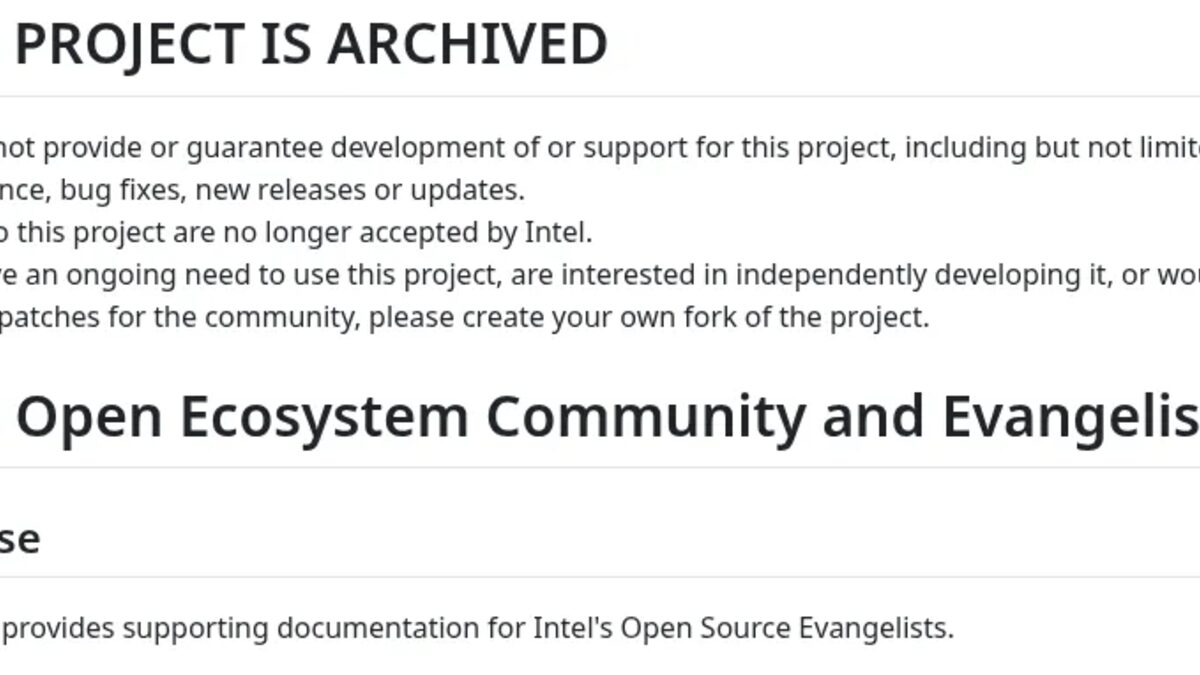
Intel just switched off the program it used to talk to the open-source world. The company archived its Open Ecosystem Community and Evangelism hub on GitHub, the outreach arm that for more than 20 years documented and promoted Intel’s open-source efforts. The page that listed its evangelists is now read-only. Nobody is staffing it.
That sounds like an internal reshuffle. It isn’t, or at least not only that. Intel has spent decades as one of the largest corporate contributors to the Linux kernel, the company whose driver and compiler work quietly made Linux run well on the chips inside most of the world’s servers and laptops. When a backer at that scale stops funding the discretionary parts of open source, the people who depend on those parts feel it. This is the moment that pattern became impossible to miss.
What Intel actually archived
The evangelism hub is the headline, but it’s the tail end of a long sequence. Phoronix, which has tracked Intel’s Linux work for two decades, reported that the program page went read-only after its last listed evangelist, Katherine Druckman, left Intel in July 2025. Nine months later, with no replacement hired, the lights went out on the page itself.
Druckman responded publicly to the archival. “My old bio was apparently the last one standing,” she wrote, calling it “nice to be named, if a little sad.” She added that the real value was “the evangelism that brought the right people into the same room to solve the most interesting problems. None of that work disappears when the program page does.” It’s a generous read. The page disappearing is still a signal about where Intel now spends.
The archiving goes well past one outreach hub. Over the past several months Intel has marked roughly two dozen repositories read-only, Tom’s Hardware reported. The casualty list reads like a tour of Intel’s technical reach:
- Embree, Open Image Denoise, and OSPRay: the ray-tracing and rendering libraries used across professional graphics and visualization tools.
- HiBench: a big-data benchmark suite Intel maintained for roughly 14 years.
- Edge AI and DPDK tooling: a predictive-maintenance demo built to show off Xeon, a high-density load balancer on DPDK, and an Edge AI performance-evaluation toolkit, all now frozen.
And in July 2025, the big one: Intel killed Clear Linux OS, its own performance-tuned distribution, with immediate effect. No more security patches, repos archived in read-only mode, users told to migrate. Clear Linux wasn’t a side experiment. It routinely topped Phoronix benchmarks as one of the fastest distributions you could install.
Why a chip company is cutting code it gives away
The short answer is money. Intel is in the middle of the deepest restructuring in its history. Under CEO Lip-Bu Tan, who took the top job in March 2025, the company told staff it planned to end the year near 75,000 core employees after cutting on the order of 25,000 jobs through layoffs and attrition. “There are no more blank checks,” Tan wrote in a memo to employees. That line explains the GitHub archiving better than any org chart.
Here’s the mechanism. Open-source work at a hardware company splits into two buckets. One bucket sells chips: the kernel drivers, the firmware, the compiler patches that make Xeon and Arc and Gaudi run well. Intel keeps funding that, because not funding it would hurt the products. The other bucket is everything that builds goodwill without a direct line to revenue: evangelism, community outreach, benchmark suites, research-y libraries, a boutique Linux distro. That bucket is exactly what a CFO trims first when the order is to stop writing blank checks.
The engineers who maintained those projects were often the same people caught in the layoffs that began in 2024 and rolled through 2025. When a maintainer is laid off or reassigned to a revenue-critical team, their project doesn’t get formally killed in a press release. It just stops getting commits. Months later, someone archives it. That’s the quiet shape of most of this list.
What an archived repo means in practice
Archiving a GitHub repo isn’t deletion. The code stays public, the history stays browsable, and anyone can fork it. What stops is the maintenance contract: no merged pull requests, no answered issues, no security releases, no new versions. The project becomes a snapshot.
For a benchmark suite, that’s an inconvenience. For something load-bearing, it’s a problem. If your rendering pipeline depends on OSPRay, or your build leans on a tool that shipped from one of these repos, you’ve inherited the maintenance. Either you fork and patch it yourself, you find a community fork to rally behind, or you migrate off it. None of those is free. The first time you discover the dependency is archived is usually the first time you learn it had a single corporate parent keeping it alive.
This is the brittleness that keeps surfacing across open source right now. We saw it when a tooling vendor’s team got absorbed into a bigger company and the roadmap shifted overnight, and again when projects moved to new homes and new governance because the original backer’s priorities changed. Even when a company opens code as a gift, the maintenance still has to come from somewhere. A repo with one funder is one budget meeting away from frozen.
The bigger picture for the Linux ecosystem
Intel isn’t abandoning Linux. That distinction matters, and the company has said it stays committed to the kernel and to open-source work that improves its hardware. The kernel will keep getting Intel patches because Intel needs them to sell chips.
What’s narrowing is the surface area. For 20 years, Intel funded a wide, fuzzy perimeter of open-source work that went beyond what strictly sold a CPU: the outreach that drew new contributors in, the libraries that other projects quietly built on, the benchmark tooling the whole industry cited. That perimeter is contracting to the line where open source meets the next chip sale. Everything outside that line is now at the mercy of a budget that has run out of blank checks.
There’s a structural lesson here that outlives Intel’s quarter. A lot of “open source” is really one company’s discretionary spending wearing an open license. It looks like a community asset until the company that pays for it has a bad year. Intel having a bad year is what turned a slow trickle of archived repos into a visible retreat. The next vendor under pressure will make the same cuts in the same order, starting with whatever doesn’t move product.
What this means for you
Audit your dependencies for single-vendor risk, not just license risk. A permissive license tells you that you can fork a project. It says nothing about whether anyone will keep maintaining it. If a library in your stack is effectively staffed by one company’s payroll, that’s a real risk to write down, the same way you’d flag a tool that ships from a startup with 14 months of runway. Check the commit graph: is it a community, or is it three people with the same employer in their email domain? For the Intel-specific projects, decide now whether each archived repo is something you patch yourself, migrate off, or bet on a community fork to revive. Don’t wait for the security advisory that never comes because nobody’s home to write it. The code Intel gave away is still yours to use. It’s just yours to maintain now too.
Share this article
Sources
- Intel Ends Open Ecosystem Community/Evangelism, Archives Other Open-Source Projects — Phoronix
- Intel shutters open-source evangelism program and archives key community projects — Tom's Hardware
- Intel announces end of Clear Linux OS project, archives GitHub repos — BleepingComputer
- Intel plans to slash 25,000 jobs in 2025 as new CEO warns, 'There are no more blank checks' — Fortune
- Intel Culls More Open-Source Projects, Community Outreach Team Shutters — BigGo
Frequently Asked
- Did Intel stop contributing to Linux entirely?
- No. Intel still ships kernel drivers and compiler work tied to its hardware. What it cut is the discretionary layer: community outreach, evangelism, and side projects without a direct path to selling silicon.
- What happens to an archived GitHub project?
- Archiving makes a repo read-only. The code stays public and you can still fork it, but Intel stops merging fixes, answering issues, or shipping releases. Maintenance becomes the community's problem.
- Which projects were affected?
- Clear Linux OS in July 2025, then a steady run including the Embree ray-tracing library, Open Image Denoise, OSPRay, the HiBench benchmark suite, and several Edge AI and DPDK tools through 2026.
- Why is Intel doing this now?
- Cost-cutting under CEO Lip-Bu Tan. Intel plans to end 2025 near 75,000 core employees after roughly 25,000 job cuts, and open-source work without a revenue tie is an easy line to trim.