A Michigan town voted against a $16B data center. The lawsuit was filed two days later.
Saline Township rejected rezoning for a 1.4 GW OpenAI-Oracle data center. Related Digital sued in 48 hours, and construction is underway.
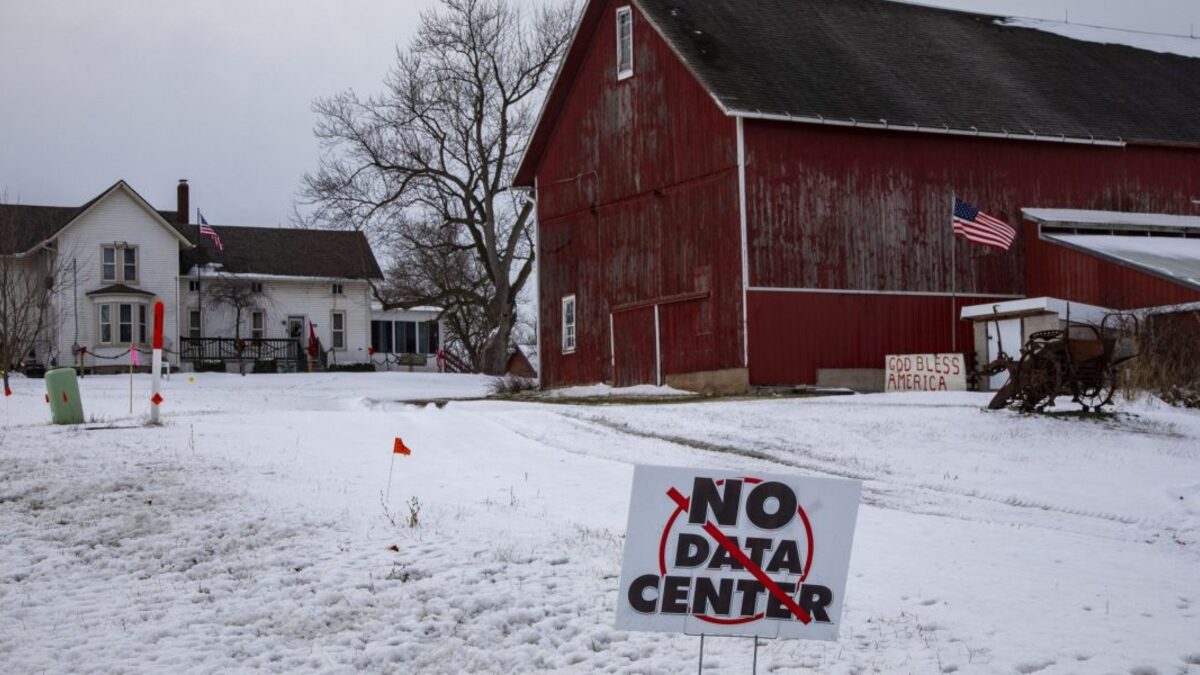
Saline Township voted 4-1 to reject a data center last September. The developer filed a lawsuit two days later. Five weeks after that, the township settled. Construction started in November.
The facility under construction is a 21-million-square-foot, 1.4-gigawatt campus on 1,000 acres of Michigan farmland, built by Related Digital for Oracle and OpenAI. It’s part of the $500 billion Stargate AI infrastructure initiative. The price tag: $16 billion, financed by Related Digital and Blackstone as of April 2026.
Township supervisor James Marion, who voted against the settlement, told Fortune: “We’re a farming rural township, and that’s what we want to stay.” He still voted against it, even after the settlement terms were on the table.
The story is already a case study in how AI’s infrastructure buildout collides with local governance. Barry Lonik, a land preservation consultant familiar with the township, told Fortune: “No other industrial project had ever tried to come in here. It’s all farmland.” He described the board as “a small township, a handful of people on the board, trying to do their jobs.”
How a vote became a formality
Saline Township has no municipal water system. Residents use private wells. The zoning code technically includes an “I-1” industrial classification, but zero parcels had ever been zoned for industrial use. It was, as Inside Climate News described it, “mere window dressing.”
Related Digital bought 575 acres from three landowners in May 2025. The planning commission rejected the rezoning proposal. The township board followed with a 4-1 vote in September.
Two days later, Related Digital and the original landowners sued, arguing Saline’s zoning was exclusionary. The legal theory was originally developed to fight racial segregation in housing. Here it was used to tell a farming community it couldn’t refuse an industrial project.
Township clerk Kelly Marion noticed the speed: “Everything was drafted and filed within two days of the meeting.” The implication is that the lawsuit was prepared before the vote happened, ready to fire regardless of the outcome.
Township attorney Fred Lucas called the settlement “the lesser of two evils.” The township’s insurance capped attorney fees at a level that couldn’t sustain a fight against a $16 billion developer. Robby Dube, attorney for resident Kathryn Haushalter, put it more sharply to Planet Detroit: “They see vulnerable communities, they move in, they go after them, and they sue them if they don’t bend.”
What the settlement actually says
The consent judgment filed October 15 limits development to 250 of the 575 acres. It preserves 200 acres of wetlands and open space, protects 47.5 acres via conservation easement, and requires closed-loop air cooling instead of water-intensive evaporative systems.
The financial terms: $4 million for a farmland preservation trust, $2 million community investment fund, $8 million for area fire services, $1.6 million minimum annual tax revenue through 2039, and $8 million annually to area schools. A 55-decibel noise cap, a decommissioning fund, and a ban on expansion round it out.
Resident Tim Bruneau told Planet Detroit the $14 million total was “probably a joke for them,” arguing the township should have negotiated far more from a $16 billion project. He’s not wrong about the math. The settlement represents less than 0.1% of the project’s financing.
The energy question
The data center needs 1.4 gigawatts of electricity, enough for roughly one million households. Michigan’s Public Service Commission unanimously approved DTE Energy contracts in December with protective conditions: a 19-year minimum contract, an 80% minimum billing demand, and a termination penalty worth up to ten years of payments.
DTE calculated a $300 million net benefit to other ratepayers. But Michigan Attorney General Dana Nessel characterized the conditional approval as a “ransom note,” and DTE is already seeking a $474 million rate increase. Michigan residential electricity bills rose 4.1% in February 2026.
Kathryn Haushalter, the 42-year-old former Marine who filed a motion to intervene in December (denied in February as too late), told Fortune: “If something gets into the water, you’re not going to know.”
A national pattern, not an isolated case
Saline isn’t an outlier. At least 142 advocacy groups across 24 states are now organizing against data center construction. An estimated $64 billion in projects have been blocked or delayed by community opposition in the last two years.
Virginia, the country’s densest data center market, has watched public support collapse from 69% to 35% in three years. Prince William County killed a $25 billion Compass Datacenters project. Seattle withdrew two proposals after 54,000 opposition messages. Maine’s legislature passed an 18-month statewide data center ban (the governor vetoed). Port Washington, Wisconsin, required voter approval before tax incentives can be offered.
Michigan alone has at least 16 potential data center sites across 10 counties. Anthropic is proposing a hyperscale facility in Lyon Township. Google is evaluating a one-gigawatt campus in Van Buren Township.
Ben Green, a researcher at the University of Michigan, told the Harvard Gazette that data center job promises are a “significant false promise.” Construction creates temporary work for a year or two. Operational facilities need only 20 to 50 permanent staff. The 1,000 acres of farmland is gone for good.
Data center opposition is becoming a bipartisan issue in ways that surprise both parties. Environmental concerns drive opposition on the left (water, energy, farmland loss). Property rights and rural character drive opposition on the right. CNBC reported in April that AI data center pushback is threatening Pennsylvania GOP incumbents in the 2026 midterms. Congress has introduced H.R. 5227 to study data center impacts on rural America.
Related Digital spokesperson Natalie Ravitz disputed what she called “misinformation” about the project’s impacts. “There was a clear national imperative to keep us competitive,” she told Fortune. She pointed to the settlement’s environmental protections and said the facility uses a “closed-loop cooling system that does not consume large amounts” of water. The developer had already paid DTE a nonrefundable $40 million deposit and ordered $2 billion in specialized equipment before the settlement was even finalized.
What this means for you
The project is part of a national boom. Over 4,000 data centers are operational in the US, with an estimated 3,000 more planned or under construction. Hyperscalers are on track to spend $700 billion on AI infrastructure in 2026 alone, according to Nikkei Asia.
If you follow AI infrastructure, the Saline story is the template to watch. A developer with deep pockets identifies cheap land near power infrastructure. The community objects. The developer sues on zoning grounds the community can’t afford to litigate. Settlement happens within weeks. Construction follows.
Governor Whitmer told Fortune: “We also want to make sure Michigan welcomes companies that will be good neighbors.” The political connection adds texture: Ryan Friedrichs, VP at Related Companies (Related Digital’s parent), is married to Michigan Secretary of State Jocelyn Benson.
There’s a political layer too. Ryan Friedrichs, VP at Related Companies (Related Digital’s parent), is married to Michigan Secretary of State Jocelyn Benson. Neither the governor’s office nor the secretary of state’s office has commented on the connection. Fortune reported that the governor’s office contacted OpenAI directly during the early site evaluation, before Related Digital purchased the land.
Resident Joshua LeBaron offered what might be the most honest forecast: “An AI stock market crash is probably the only thing that could stop it.”
Share this article
Sources
- A Michigan farm town voted down plans for a giant OpenAI-Oracle data center. Weeks later, construction began. — Fortune
- Saline data center settlement — Planet Detroit
- Why are communities pushing back against data centers? — Harvard Gazette
- The anti-AI data center rebellion keeps growing bigger — MarketWise
- MPSC approves DTE Electric energy contracts for data center — Michigan.gov
Frequently Asked
- Where is the data center being built?
- Saline Township, Washtenaw County, Michigan, on 1,000 acres of farmland about 50 miles west of Detroit. The project uses 250 of the original 575 acres proposed for development.
- Who is building it and for whom?
- Related Digital (a subsidiary of Related Companies) is the developer. Oracle is the primary tenant. OpenAI is the end user through the Stargate initiative. Blackstone co-financed the $16 billion project.
- How did construction proceed after the town voted against it?
- Related Digital filed an exclusionary zoning lawsuit two days after the September 2025 vote. The township, unable to afford extended litigation, settled within five weeks. The consent judgment rezoned the land with conditions.
- How much power will it use?
- 1.4 gigawatts, enough for roughly one million households. DTE Energy's contracts include a $300 million net benefit to other ratepayers and a rate freeze if the facility comes online by end of 2027.