Anker built its own AI chip. It runs neural nets inside flash memory cells.
Anker's Thus chip embeds compute inside NOR flash, claims 150x more on-device AI for noise cancellation, and ships in Soundcore earbuds on May 21. Here's why it matters.
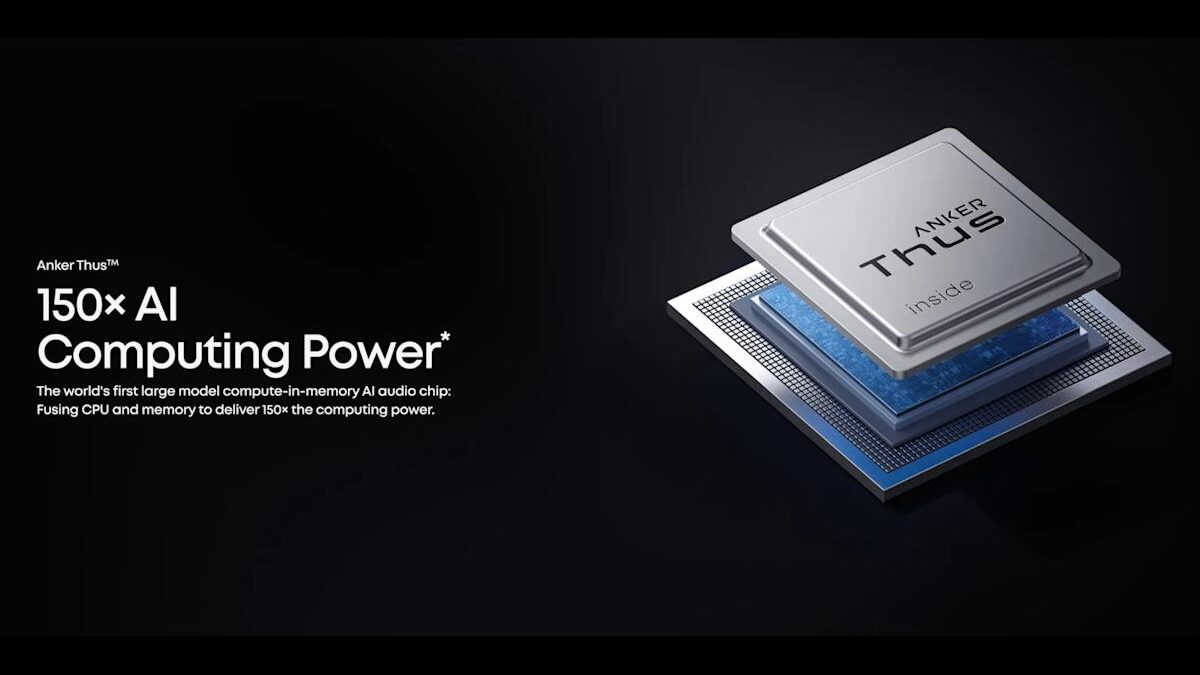
Anker, the brand best known for $30 USB chargers, just designed a custom AI chip. It’s called Thus, and it doesn’t run neural networks the way every chip in your laptop does.
The company announced Thus on April 22 as the silicon behind a forthcoming Soundcore earbud, with a fuller reveal scheduled for the May 21 Anker Day event in New York. The pitch is bold: a few million parameters of on-device AI running in the milliwatt power budget of a true wireless earbud. The architecture that makes it work isn’t something Apple, Qualcomm, or MediaTek currently ship.
Compute-in-memory, in plain English
A normal chip splits the work. Memory holds your model weights. A processor pulls those weights out, multiplies them against your input, and writes the answer back. That round trip burns most of the energy. According to Anker’s pitch, over 90% of the power in a traditional inference cycle is spent moving data around, not computing on it.
Compute-in-memory (CIM) collapses the round trip. The model parameters live inside the memory cells, and the computation happens where the parameters are stored. Thus puts the weights inside NOR flash cells, then uses a controller to modulate the resistance of each gate so the array of cells acts as the matrix-multiply engine. There’s no separate CPU core doing the math. The flash is the math.
The numbers Anker is publishing put a frame on it. The chip is reported to deliver around five billion operations per second, which sounds modest next to a phone NPU, but the relevant comparison is power, not throughput. Existing earbud DSPs top out at a few hundred thousand parameters of neural network. Thus pushes that ceiling into the millions, and Anker is claiming 150 times more AI compute for noise cancellation than its previous flagship soundcore generation. That number is a vendor benchmark, so treat it as marketing until reviewers test it. But the architectural shift is real.
Why earbuds first, then everything
Headphones are the worst case. There’s no room for a heatsink, the battery is the size of a peanut, and the user expects you to cancel the sound of a subway train at 16 ms of latency. If your AI chip works there, it’ll work in a smart-home plug or a pocketable scanner.
That is why Soundcore is the launch vehicle. The first product is described as a flagship Soundcore model with eight MEMS microphones plus two bone-conduction sensors feeding a “Clear Calls” voice-isolation pipeline. After audio, Anker says it intends to roll Thus into mobile accessories and IoT devices. Read that as: smart plugs, security cameras, the Nebula projector line, and probably the eufy household lineup. The chip is fabricated in Germany, which is unusual enough on its own to be worth flagging.
The strategic move is bigger than one earbud. Anker has been a system integrator, buying audio DSPs from Qualcomm and Broadcom and tuning them. Designing your own silicon is a different posture, and it is the same posture Apple took for AirPods and Sony took for the WH-1000XM5. The difference is Anker is doing it at a price point where the BOM normally cannot accommodate custom silicon. CIM is what makes the math work: a NOR-flash CIM die is cheaper to fab than a 5 nm SoC, and most of the die area is memory, not logic.
Why the architecture is having a moment
Compute-in-memory has been a research darling for a decade and a commercial vapor cloud for almost as long. Mythic AI, Syntiant, GreenWaves, EnCharge, and a parade of academic spin-outs have all pitched some version of it. The reason it is suddenly shipping is twofold.
First, the model side caught up. A million-parameter audio model that used to be a research artifact is now a perfectly reasonable transformer for noise suppression and speaker separation, thanks to better distillation and quantization. Second, the alternative is getting expensive. Cloud-side inference for consumer audio is a non-starter on latency and privacy, and putting a Cortex-M plus DSP combo in every earbud has hit a power wall. CIM is one of the few paths that gives you another decade of headroom, alongside neuromorphic and analog AI.
The same week Anker shipped Thus, Google split its AI chip line at Cloud Next and Meta locked in a Broadcom co-design deal for hyperscaler-class silicon. Those are 2 nm, 1-gigawatt deployments. Anker is at the opposite end of the same pendulum: the smallest device that can usefully run a neural net on its own power budget. Both ends are now interesting, and both ends are now custom.
The bigger question is how Apple, Sony, and Bose respond. Apple’s H2 chip in the AirPods Pro 3 is a conventional NPU+DSP design fabricated by TSMC. Sony uses an in-house QN3 processor with a similar topology. Neither has hinted at moving to compute-in-memory, though both have research groups that have published on the technique. If Anker can credibly demonstrate that a CIM die delivers better-than-flagship noise cancellation at a fraction of the silicon cost, the next AirPods refresh suddenly has a competitive problem that doesn’t show up in a spec sheet, because the architectures aren’t directly comparable. The marketing will be ugly. The engineering question is whether CIM scales beyond a single audio model. Anker says it does. The Soundcore launch will say more than the press release does.
What to actually watch on May 21
The Anker Day reveal will name an earbud SKU, a price, and presumably a performance comparison against the Soundcore Liberty 4 NC. The numbers to scrutinize:
- Cancellation depth in dB at conversational speech frequencies, not at the 60-Hz airliner drone where every vendor cherry-picks. The 150× number is for this metric.
- Battery life with ANC on, because CIM is supposed to win on power. If the new earbud delivers fewer hours than the previous flagship, the architecture story is overstated.
- Latency, especially for “transparent voice” modes that have to round-trip mic to neural net to driver in under 30 ms.
- Whether Anker publishes a tooling SDK for the chip, or keeps it Soundcore-internal. An SDK is what would let third parties build on Thus and turn it from a product feature into a platform.
What this means for you
If you buy earbuds, the immediate effect is one more flagship in the noise-cancellation race, this time from a brand that competes on price. Expect Soundcore to undercut the AirPods Pro 3 and the WH-1000XM6 at launch. If you build for hardware, Thus is a real signal that compute-in-memory is exiting the research phase, and the next wave of “AI in everything” devices is going to look different from the Cortex-M-plus-NPU stack you have been targeting. Watch whether competitors pivot to CIM in the next 12 months, or whether they double down on conventional NPUs and let Anker have the niche.
The catch: a single-vendor benchmark is not a product review. The 150× number, the 5-billion-ops figure, and the milliwatt power budget all need independent measurement before anyone should plan around them. Wait for the May 21 reveal, then wait for the third-party tear-down. Then decide whether the architecture lives up to the architecture diagram.
Share this article
Sources
- Anker's 'Thus' chip brings AI to its headphones and other products — Engadget
- Anker's THUS AI Chip Platform Brings Neural-Net AI To Consumer Devices — Ground News
- Anker Thus: Tiny AI memory chip improves noise cancellation — heise online
- Anker is betting its new chip can change how AI runs in earbuds — TechSpot