Flipper Zero's 700 KB flash wall: the firmware future is now community-driven
Flipper Devices says the Flipper Zero isn't abandoned, but a 700 KB flash limit is pushing firmware work onto the community while its team builds new hardware.
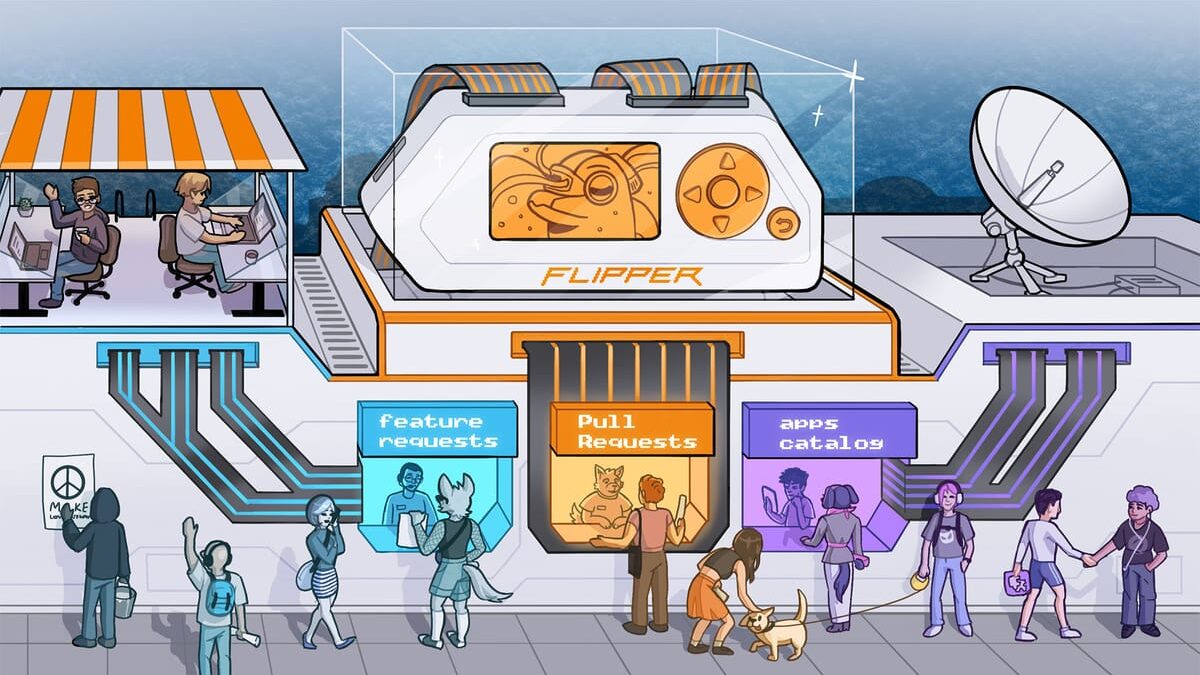
Flipper Devices spent this week reassuring worried fans that the Flipper Zero isn’t dead. The reassurance came with a catch. The firmware will keep shipping, but a smaller in-house team is now handing much of the work to volunteers, under stricter rules, and driven by a hard limit inside the device itself: 700 KB of flash.
For the more than one million people who own a Flipper Zero, the message is blunt: updates keep coming, but their pace and direction now ride on outside contributors as much as on Flipper’s own engineers. Rumors that the pocket hacking tool had been quietly abandoned had been building for months. The company laid out its answer in a July blog post that reads as part roadmap, part request for help.
What the Flipper Zero actually does
The Flipper Zero is a $169 pocket multi-tool for poking at the wireless world around you. It reads and emulates RFID and NFC cards, records and replays sub-GHz radio from things like garage remotes, speaks infrared to your TV, and talks to other hardware over its GPIO pins. It looks like a Tamagotchi with a dolphin mascot, which is part of why it went viral and part of why it keeps getting banned in places like Canada and Brazil.
None of that is changing. What’s changing is who writes the code that makes it do more. Since the firmware reached 1.0 in September 2024, owners have treated new features as a steady drip from the company, and lately that drip had slowed enough to spook people. The last official firmware release, version 1.4.3, shipped back in December 2025, and the long quiet since then is exactly what fed the abandonment talk. Flipper’s answer is that the drip now depends on the community stepping up, not on the core team growing.
Why the firmware ran out of room
Here’s the constraint that drives everything else. In the blog post, Flipper is blunt about the ceiling: “Flipper Zero has only 700 KB of flash memory available for firmware,” it writes. That space is full. You can’t keep bolting new radios, parsers, and menus into a binary that no longer fits on the chip.
So the team changed the model. Instead of packing every capability into the core firmware, Flipper leaned on loading code at runtime. “To work around it, we came up with dynamic apps loading from the microSD card,” the post explains. In practice, the newer stuff (extra protocol decoders, games, one-off research tools) lives as separate app files on the SD card and loads on demand, rather than getting compiled into the base image everyone flashes. Flipper’s own app catalog already works this way, so the plumbing exists and thousands of community apps already ship through it.
That matters because the flash ceiling isn’t a bug they can patch away. It’s the physical size of the storage baked into the chip, so every kilobyte a new feature would add to the core has to come out of something else. Moving features into loadable apps is the only way to keep growing without a hardware revision, and a hardware revision would mean a new device, not a new Flipper Zero.
That design choice is why the community angle isn’t optional. When the core is frozen by a hard flash budget, most growth has to happen in app-land. And app-land is exactly where outside developers already build.
New gatekeeping for community code
More community code means more risk, so Flipper is tightening how contributions get in. Feature requests now route through voting in GitHub Discussions, and the team says it will review the highest-voted items weekly. Direct social-media messages got switched off. With over a million users, the inbound had become unmanageable, so everything funnels to one public tracker instead.
Pull requests face a higher bar too. “we’ll now evaluate pull requests more strictly,” the company wrote, pointing to an updated contribution guide, and it singled out one category in particular: “This applies especially to AI-generated code that touches low-level libraries that is hard to verify.” That caveat isn’t paranoia. On a device that speaks directly to radios and card readers, a subtle bug in a low-level driver can brick hardware or quietly break a protocol, and reviewers can’t always spot machine-written code that looks right but reasons wrong. UI changes now have to arrive with matching documentation, and every firmware change is meant to run through public integration test cases, with the community pitching in on regression testing.
Read cynically, that’s a company offloading maintenance onto unpaid volunteers. Read charitably, it’s the standard playbook for a mature open-source project that can’t scale its core team past a certain point. Both readings are true at once. Neither is unusual for hardware that sells in the hundreds of thousands.
The team’s real focus is new hardware
The subtext of the whole post is where Flipper’s energy actually goes. “our team is still small, and all our attention right now is on building new DEVICES,” the company wrote. Two devices, specifically.
Its headline bet is the Flipper One, an open, Linux-powered networking and hacking platform that Flipper announced in May but isn’t selling yet. This is a different class of machine than the Zero, aimed at higher-level protocols like Wi-Fi, 5G, and Ethernet rather than short-range radio. The reported hardware is an octa-core Rockchip RK3576 running Debian 13 Linux, with dual Ethernet and a rumored price somewhere between $300 and $500. Rather than ship it finished, Flipper is asking developers to help build the software, with a stated goal of making “the most open and best-documented ARM computer in the world.” It has already published the enclosure files on GitHub and stood up a Flipper One development portal so people can start hacking on the hardware and the OS before launch. Plenty of the software still doesn’t exist, which is the point of the recruitment drive, and it’s also why there’s no firm ship date yet.
Busy Bar is the odd one out, with nothing to do with hacking. It’s a focus gadget aimed at neurodivergent users, especially people with ADHD: a physical bar with a 72-by-16 LED matrix, a Pomodoro timer, cross-device app blocking, and Matter smart-home control. It goes on sale July 14, at $199 for the first 3,000 buyers and $249 after that, with waitlist members paying $179. Shipping starts the same day to the US, EU, UK, and Canada, and companion apps for iOS, Android, and macOS launch alongside it, with a Windows app still in the works. The firmware is open, which is the through-line here: even the productivity gadget is built to be hacked.
What this means for you
If you own a Flipper Zero, your device isn’t going anywhere, but recalibrate your expectations. The big built-in feature drops are largely behind you now. Growth lives in SD-card apps and in whatever the community ships through the new PR process. If there’s a capability you want, the realistic path is voting for it in GitHub Discussions or building it yourself, not waiting for Flipper to hand it down from above.
If you’re a security researcher or tinkerer, this is the moment to get involved. A frozen core, an open app model, and an explicit call for contributors add up to about as clear an invitation as a hardware company ever gives. And if you were eyeing the Flipper One as your next toy, don’t hold your breath: it’s a build-it-with-us project right now, not something you can buy. Watch the app repos and the GitHub vote tallies. That’s where the Flipper Zero’s next year gets written.
Share this article
Sources
- The Future of Flipper Zero Development — Flipper Devices
- Flipper Zero firmware development continues with community help — BleepingComputer
- The Team Behind The Flipper One Needs Your Help — Hackaday
- The Flipper One: Hacking Gadget is Becoming a Pocket Linux PC — Mobile Hacker
- Flipper unveils a Linux-powered networking gadget built for hackers and tinkerers — TechCrunch
- Flipper Devices' new Busy Bar is a customizable display for productivity — TechCrunch
Frequently Asked
- Is Flipper Devices discontinuing the Flipper Zero?
- No. The company says firmware updates will continue, but a smaller internal team now relies on community contributions to keep them coming.
- Why can't Flipper just add more features to the firmware?
- The Flipper Zero has only 700 KB of flash for firmware and the team hit that ceiling. New capability loads as separate apps from the microSD card instead.
- What is the Flipper One?
- An open, Linux-powered networking and hacking platform Flipper has announced but isn't selling yet. It runs on a Rockchip chip, and the company is asking the community to help build the software.