GLM-5.2 was trained on Huawei chips, not Nvidia. The open weights beat GPT-5.5 on coding.
Zhipu AI's GLM-5.2 is a free-to-download model trained without Nvidia silicon. Here's what the benchmarks claim and why developers should care.

Zhipu AI just put a frontier-class language model on the internet for free. The model is GLM-5.2, and on June 17 the Chinese lab published its official benchmarks and the full weights on Hugging Face under an MIT license. Two things make it worth a look: the scores rival the best closed models, and Zhipu says it trained the model without a single Nvidia chip.
That second part is the one that has people in Washington and Santa Clara paying attention. For three years the working assumption behind US export controls was that China could not train a top-tier model without smuggled or rationed Nvidia hardware. GLM-5.2 is the loudest counterexample yet, and because the weights are open, nobody can put it back in the box.
What GLM-5.2 actually is
GLM-5.2 is a 753-billion-parameter model that activates only about 40 billion parameters per token, the MoE design that lets a huge model run at the cost of a much smaller one. It ships with a 1-million-token context window, it is text-only (no image input), and the full weights weigh in around 1.5TB. Zhipu released it under the MIT license, which is the permissive end of open: download it, fine-tune it, ship it in a product, no strings, no regional lock.
The “open weights” label is doing real work here, so it’s worth being precise. You get the trained parameters, not the training data or the recipe. But that’s enough to run the model yourself, audit how it behaves, or build a product on top of it without asking anyone’s permission. Once a file like that is on Hugging Face and mirrored a thousand times, no government can revoke it. That permanence is the whole point of the release, and it’s what separates an open-weights drop from a closed API that a vendor can throttle, reprice, or geofence at will.
Zhipu, which now brands itself Z.ai, has been shipping the GLM family at a steady clip. GLM-5 landed in February as a 745B model that performed within single digits of GPT-5.2 on major benchmarks, GLM-5.1 followed, and 5.2 is the long-horizon coding refinement. The lab has been on the US Entity List since January 2025, according to reporting on the release, which makes shipping an unrestricted open model a pointed move. A company the US tried to wall off is now handing its best work to the entire planet for nothing.
The benchmark claims, and who’s checking them
Here’s where hedging matters. Zhipu’s own numbers are bullish. On SWE-bench Pro, the test that throws real GitHub issues at a model and checks whether the fix passes, Zhipu reports GLM-5.2 scoring 62.1 against GPT-5.5’s 58.6, with a similar lead on the FrontierSWE benchmark. Vendor benchmarks always flatter the vendor, so treat those as the claim, not the verdict.
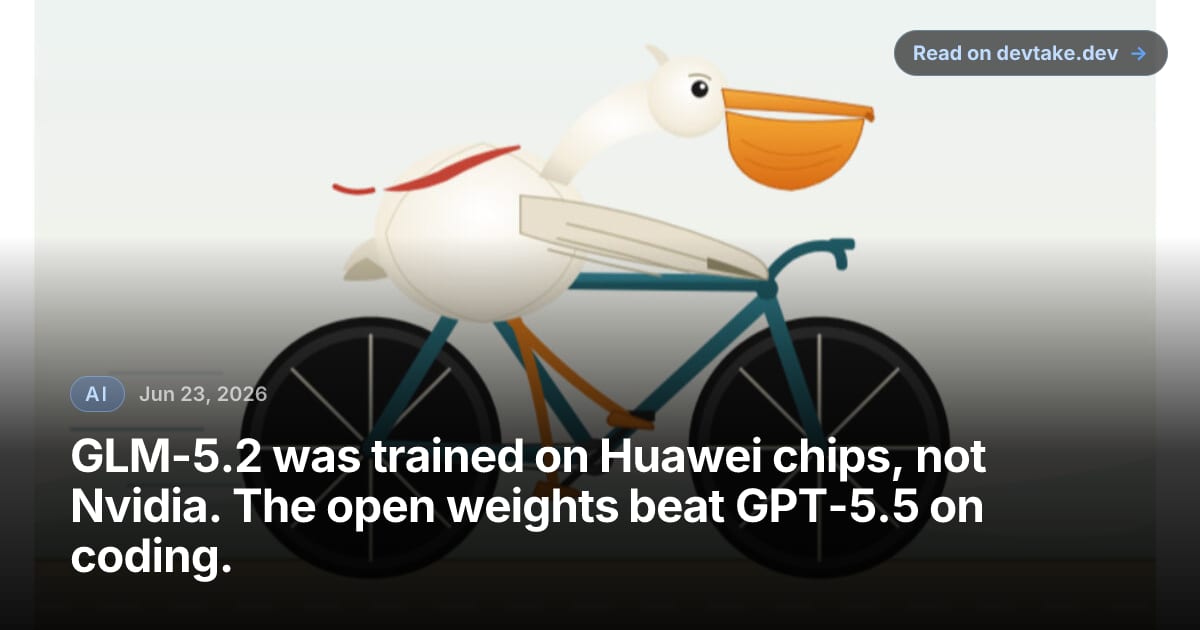
The more useful read comes from outside the company. Independent analyst Simon Willison ran the model and called it the real thing. “GLM-5.2 is the leading open weights model on the Intelligence Index v4.1,” he wrote, citing the third-party Artificial Analysis index where GLM-5.2 scores 51, ahead of MiniMax-M3 and DeepSeek V4 Pro at 44. On his standard “draw a pelican on a bicycle as an SVG” test, Willison noted the result was “a self-contained fully animated SVG, and the animations aren’t broken.” That’s a low bar phrased as a joke, but it’s a human checking the output rather than a marketing slide.
The gaps are real too. On SWE-Marathon, the punishing long-horizon agentic test where a model has to keep its head straight across hundreds of steps, GLM-5.2 scores 13.0 against Claude Opus 4.8’s 26.0. So it is not the best coding model on earth, and anyone telling you it dethroned the frontier labs is overselling. It is, plausibly, the best one you can download for free, and it costs a fraction of the closed alternatives to run through an API, roughly one-sixth the price of GPT-5.5 for comparable coding work. Willison clocked the API at around $1.40 per million input tokens and $4.40 per million output, which is cheap for this tier.
The honest summary: GLM-5.2 trades blows with the closed models on short, well-scoped coding tasks and falls behind on the marathon agentic stuff that the best paid models still own. For a free, downloadable model, that’s a remarkable place to land.
You can run it on a Mac
This is the part that turns a geopolitics story into something you can touch. A 1.5TB model sounds like data-center-only territory, but quantization shrinks it hard. Unsloth published dynamic GGUF builds that fit consumer-ish hardware: the 2-bit version needs about 245GB of combined memory and runs on a 256GB unified memory Mac, or on a single 24GB GPU paired with 256GB of system RAM and MoE offloading.
Quantization is lossy, so the cheap builds give up accuracy. Unsloth pegs the 1-bit version at roughly 24% less accurate than the full model, while the 4-bit and 5-bit builds are described as “mostly lossless.” A maxed-out Mac Studio is still a several-thousand-dollar machine, so this is not “runs on your laptop” for most people. But it is “runs on hardware a small team can buy,” with no API key, no rate limit, and no data leaving the building. For anyone who has watched local coding setups mature, this slots right into the local-agent stack people are already building on Apple silicon.
Why the Huawei chips are the real story
Strip away the benchmark bragging and the durable headline is the supply chain. The entire GLM-5 family was trained on roughly 100,000 Huawei Ascend 910B chips using Huawei’s MindSpore framework, China’s homegrown answer to PyTorch, with zero Nvidia GPUs anywhere in the loop. Zhipu said plainly that “no Nvidia hardware was used in the training process.” For a model this size, that’s not a science-fair stunt. It’s a production training run on domestic silicon at a scale most labs can’t reach on any hardware.
That sentence is the one US policy did not want to hear. The whole theory behind tightening chip export controls, the same theory driving the pressure on Taiwan to curb AI-chip exports to China, is that frontier training needs Nvidia-class hardware that the US can ration. A 753B model that posts GPT-5.5-adjacent coding scores on domestic silicon undercuts that premise. It does not erase Nvidia’s lead, training efficiency on Ascend reportedly still lags, but it proves the path exists.
Pair that with the open release and you get a specific kind of pressure. While US regulators were still arguing over whether to blacklist DeepSeek, Zhipu shipped a competitive model that anyone, anywhere, can download and keep forever. Controls can slow imports. They can’t recall a file that’s already mirrored across every continent.
What this means for you
If you write code and you’ve been renting intelligence from OpenAI or Anthropic by the token, GLM-5.2 is worth a real evaluation, not a glance. Point it at your actual codebase through the API first, because that’s cheap and tells you whether the coding scores hold up on your problems rather than the benchmark’s. If they do, the open weights give you a fallback that no vendor can price-hike or deprecate out from under you. Just budget for the hardware honestly: this is a 256GB-Mac or multi-GPU commitment to self-host, not a free lunch. And watch the next quarter. If a Huawei-trained open model can trade blows with GPT-5.5, the assumption that the frontier stays locked behind export controls is the thing that just broke, and the open-weights field is where the consequences land first.
Share this article
Quick reference
- open weights
- A model whose trained parameters are published for download, so anyone can run or fine-tune it locally. It does not always mean the training data or code is open.
- MoE
- Mixture-of-experts, a model design that routes each request to a small subset of specialized sub-networks, so a 1.2-trillion-parameter model only fires a fraction of itself per query.
Sources
- GLM-5.2: Built for Long-Horizon Tasks — Z.ai
- GLM-5.2 is the leading open weights model on the Intelligence Index — Simon Willison
- Z.ai trained GLM-5.2 with only Huawei chips, no Nvidia — DigitalToday
- Run GLM-5.2 locally — Unsloth
Frequently Asked
- What is GLM-5.2?
- GLM-5.2 is a 753-billion-parameter large language model from the Chinese lab Zhipu AI (Z.ai), released under an MIT license with full open weights and a 1-million-token context window. It is text-only and tuned for long-horizon coding and agentic tasks.
- Is GLM-5.2 actually free to use?
- The weights are free. Zhipu published them on Hugging Face under the MIT license, so you can download, modify, and deploy the model commercially with no usage restrictions or regional locks. You still pay for the hardware or API calls to run it.
- Can I run GLM-5.2 on my own machine?
- Yes, with enough memory. Unsloth's quantized GGUF builds run the 2-bit version in about 245GB of combined RAM and VRAM, which fits a 256GB unified-memory Mac. Smaller quants trade accuracy for size; the 1-bit build is roughly 24% less accurate than the full model.
- Why does the Huawei chip detail matter?
- US export controls are meant to slow China's access to top-tier AI training hardware. A frontier-class model trained entirely on Huawei Ascend chips suggests those controls are leakier than intended, at least for training.