GM is spending $900 million on a battery bet that could cut $6,000 off an EV truck
GM is pouring $900M into a new LMR battery plan, betting a cheaper chemistry gets its EVs to price parity with gas trucks by 2028. Here's the play.
GM is betting $900 million that a cheaper battery gets electric trucks to the same sticker price as gas ones. The wager runs through a new cell development center near Detroit and a chemistry called LMR, short for lithium manganese rich. GM’s pitch, laid out by TechCrunch this week, is that LMR gives a truck most of the range of today’s expensive nickel cells at close to the cost of the cheap ones.
If it works, the Chevrolet Silverado EV gets about $6,000 cheaper to build. That’s not a tweak. That’s the kind of number that flips a buyer’s spreadsheet.
That gap, the price difference between an EV and the gas version of the same vehicle, is the whole game right now. American EV buyers have proven they’ll cross over when the math works and stall when it doesn’t. GM’s vice president of battery, Kurt Kelty, put the stakes plainly: “We need to get price parity with (internal combustion engine vehicles) and then this thing’s just going to take off.” The $900 million is GM trying to buy its way to that number faster than its rivals.
What LMR actually is
Most EVs today run one of two battery types. There’s the nickel-heavy stuff (NMC, for nickel manganese cobalt) that holds a lot of range but costs a fortune because nickel and cobalt are pricey and mostly mined abroad. And there’s LFP, the iron-based chemistry that’s cheap and safe but heavier, so it stores less range per pound. Carmakers have spent years stuck choosing between range and cost.
LMR is GM’s attempt to stop choosing. It strips most of the nickel and cobalt out and leans on manganese, which is cheap and plentiful. GM says the result lands close to LFP on cost while keeping much of the range you’d expect from a nickel cell. The company claims its new LMR design unlocks 33% higher energy density than the best LFP cells at a comparable price. For a buyer, that’s the difference between a 250-mile cheap EV and a 400-mile one that costs about the same to build.
There’s a second trick here that’s easy to miss. GM is moving these cells to a prismatic cell format, a rigid rectangular can, instead of the flat pouches it uses now. Reuters reported the switch cuts the number of parts in the battery pack by more than 50%. Fewer parts means less assembly, less weight, and less cost. The chemistry and the format are doing the savings together.
Why the $900 million goes to a building, not a factory
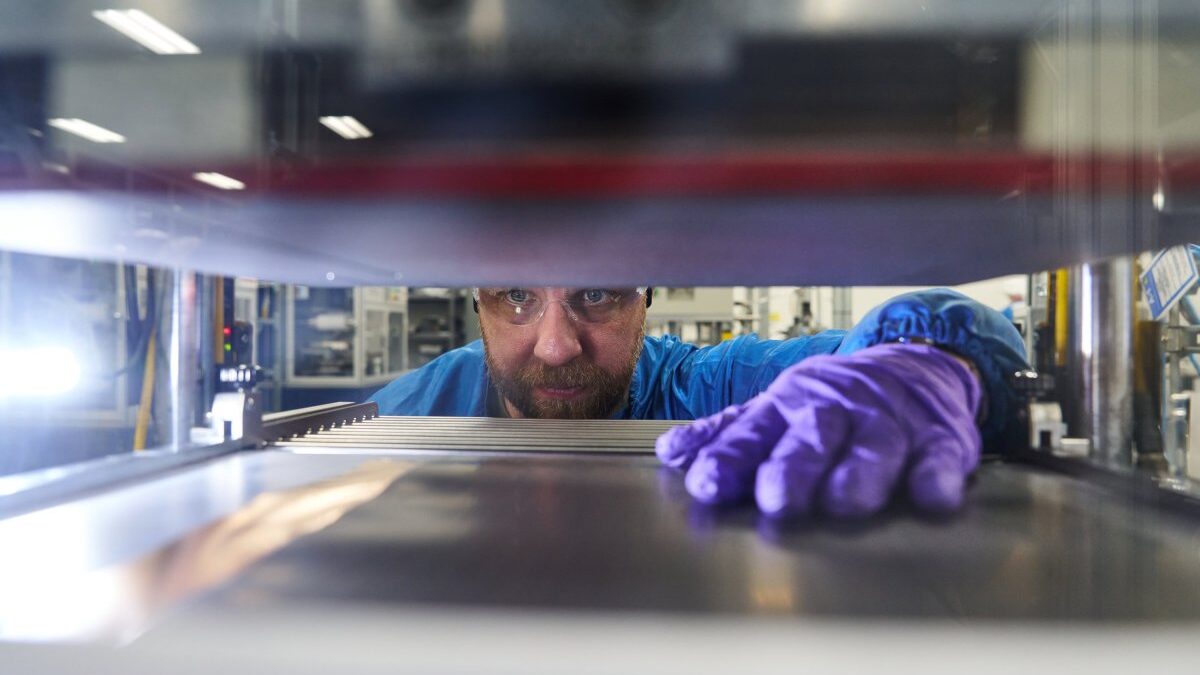
The money isn’t for a giant cell plant. It’s for the Ancker-Johnson Battery Cell Development Center at GM’s Warren Tech Center outside Detroit, a 500,000-square-foot pilot facility that TechCrunch toured before the news broke. Think of it as the bridge between a chemistry that works in a coin-sized lab sample and one you can stamp out by the millions on a real production line.
That gap is where battery programs die. A recipe that’s perfect in the lab can be a nightmare to scale, and the cost of finding out is brutal. The center can build roughly 2,500 cells a day, about 0.5 GWh a year, and each test run runs around $200,000. Kelty described the handoff from research to volume as the hard part: “Once you learn how to make the recipe in Wallace, then you’ve got to figure out, well, how do you make this in high volume?” The pilot line is GM rehearsing that step on its own floor before it commits a real factory to it. First batches are expected later in 2026, with the work running up to a year faster than originally planned.
How GM’s bet compares to its rivals
GM isn’t alone on LMR. Ford announced its own LMR breakthrough in April 2025, chasing the same idea: nickel-cell range at LFP-ish cost. But Ford is hedging harder. It’s also poured over $3 billion into a plant making LFP cells under license from China’s CATL, so if LMR slips, it still has a cheap chemistry shipping.
Tesla took a different road. It’s standing up its first North American LFP line in Sparks, Nevada, reportedly using old CATL equipment, with prismatic LFP production targeted for 2026. Tesla’s bet is that proven, dirt-cheap LFP at home beats a fancier chemistry that’s harder to make.
So three big American automakers, three reads on the same problem. Tesla says cheap and proven wins. Ford wants both bets covered. GM is leaning hardest into LMR as what Kelty called the company’s “bread and butter,” its “main product line.” GM plans to keep LFP and nickel cells around for the cheapest and the most premium vehicles, but LMR is meant to carry the volume in the middle, the trucks and SUVs where Americans actually spend. Pickups and large SUVs are GM’s profit engine, so betting the new chemistry on that segment is also a bet on the company’s bottom line, not a side experiment.
The risks GM is taking on
LMR has a history, and it’s not all good. The chemistry has struggled for years with voltage fade, where the cell slowly loses capacity over hundreds of charge cycles, plus a tendency to lose efficiency as it ages. Manganese-rich cathodes can also shed metal into the electrolyte over time, which eats at the cell’s life. That cluster of problems is exactly why LMR has stayed a lab curiosity while LFP and nickel cells went mainstream. GM says it’s solved enough of this to commit, having logged over 150 million CPU hours simulating the chemistry before building real cells. But simulations aren’t road miles. The real test is a few hundred thousand trucks charging in Phoenix summers and Minnesota winters for a decade, and nobody on the planet has that data for LMR yet.
Then there’s timing. Commercial production through the Ultium Cells joint venture with LG isn’t slated until 2028, with pre-production at an LG plant by late 2027. That’s a long runway, and the EV market keeps shifting under it. Federal EV incentives have already been cut back, and tariffs on imported battery materials swing with each policy cycle. GM is making a multi-year, billion-dollar-scale chemistry bet against a market whose rules change every few months. If LFP costs keep falling faster than expected, the whole “range at LFP cost” advantage narrows.
What this means for you
If you’re eyeing an electric truck or SUV and the price has been the thing stopping you, GM’s bet is aimed straight at you, but not until 2028. The promise is real: a Silverado EV that costs about $6,000 less to build should eventually show up as a lower sticker, and 400 miles of range at that price would make the gas version a genuinely harder sell. The catch is that this is a 2028 product riding on a chemistry that’s never shipped at volume. If you’re shopping this year or next, today’s LFP and nickel EVs are what you’ll actually be choosing between. Watch for two things between now and then: whether GM’s first pilot cells later in 2026 hold up under real charge cycles, and whether the 2028 timeline holds when the market wobbles again. The technology is promising. The schedule is a bet.
Share this article
Quick reference
Sources
Frequently Asked
- What is LMR battery chemistry?
- LMR stands for lithium manganese rich. It swaps most of the expensive nickel and cobalt in a cell for cheaper manganese, aiming for the range of nickel cells at close to the cost of LFP.
- How much is GM actually spending?
- About $900 million on a battery cell development center at its Warren Tech Center near Detroit. That money funds the pilot line that bridges lab research and mass production, not the full factory.
- When will these batteries reach cars?
- GM is targeting 2028 for commercial LMR cells through its Ultium Cells joint venture with LG, with pre-production at an LG plant expected by late 2027.
- Is this the same thing Ford is doing?
- Both chase the same goal, cost parity with gas cars, but Ford is also building LFP capacity licensed from China's CATL, while Tesla is standing up its own LFP line in Nevada. GM is betting harder on LMR as the volume product.