Realta Fusion pulled electricity straight from a fusion plasma. That's a first, not net power.
Realta Fusion says it converted fusion plasma energy directly into electricity on its WHAM device, an apparent industry first. It is not net-energy gain.
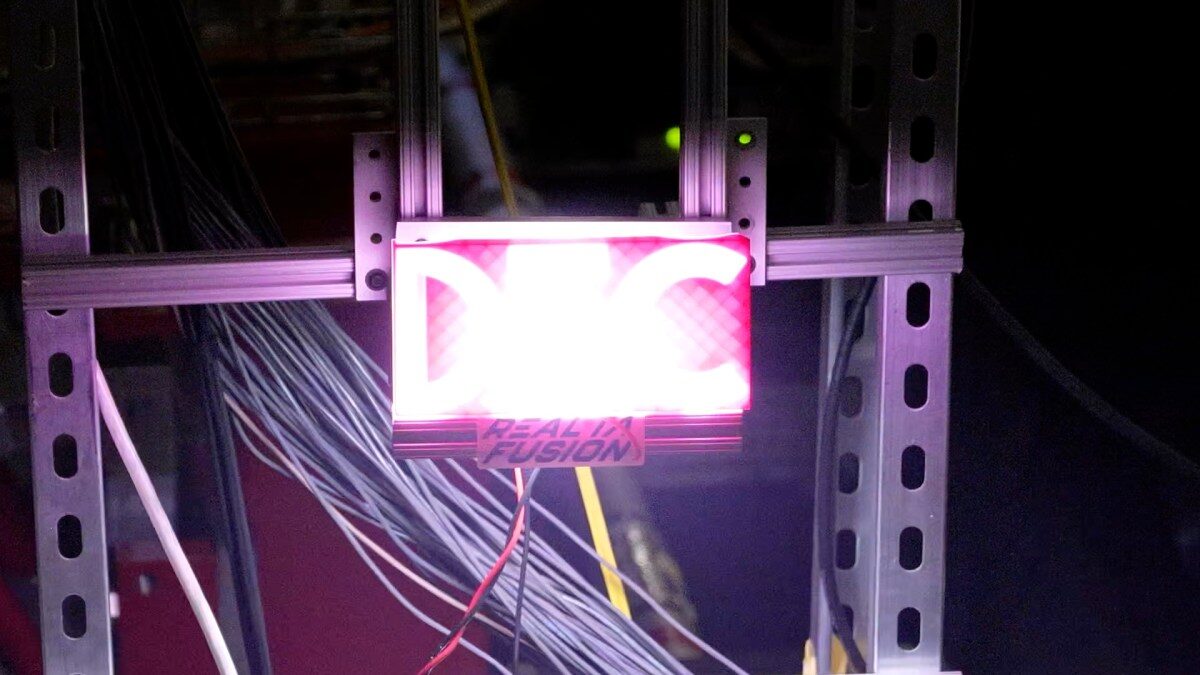
Realta Fusion says it pulled electricity straight out of a fusion plasma. On June 19, the Wisconsin startup lit several bulbs using current harvested directly from WHAM, its demonstration reactor, and calls it an apparent industry first. The number that matters is not the wattage. It’s what the company is careful not to claim.
Direct energy conversion, or DEC, skips the steam. Every commercial nuclear plant running today boils water, spins a turbine, and throws away roughly two-thirds of the heat. Realta says it captured the energy of charged particles flying out of its plasma and turned that motion into current with no turbine in the loop. If that scales, it changes the economics of fusion, because a plant that skips the turbine is cheaper to build and wastes less of what it makes. The word doing the heavy lifting is if.
What we know
The rig lit bulbs, but the reason to care sits in how it did it: no boiler, no turbine, just charged particles slowing against an electrode. Here’s what Realta has confirmed, with receipts:
- The demonstration ran on June 19, 2026, on the Wisconsin HTS Axisymmetric Mirror (WHAM), the machine Realta operates with the University of Wisconsin-Madison, per the company’s own release.
- The converter “works by slowing down charged particles at one end of the machine, which builds up an electrical potential or voltage to drive an electrical current,” Realta wrote. The rig produced multiple amps at around 100 volts.
- Realta harvested “alpha power,” the charged helium nuclei that carry roughly 20% of the energy from deuterium-tritium fusion, TechCrunch reported.
- CEO Kieran Furlong pegs direct conversion at “about 90% efficient” against the roughly 33% you get from a steam turbine, according to TechCrunch. “We can take power from a plasma,” he said.
- The approach is a magnetic mirror: a straight cylinder that traps plasma between two sets of high-temperature superconducting magnets, rather than the doughnut-shaped tokamak most of the field chases. Realta spun out of UW-Madison, which set a world record for steady magnetic field strength in fusion plasma on WHAM in 2024.
That last point is why the claim is narrow. A tokamak’s fuel loops around a ring, so there’s no clean exit for charged particles to convert. A mirror leaks plasma out its ends by design, which is usually a loss. Realta’s bet is to catch that leak and monetize it.
What we don’t know
The honest caveats came from Realta itself, not a skeptic. “While we’ve demonstrated DEC works on WHAM, this is not yet a demonstration of net-electricity or a large-scale conversion of fusion power directly into electricity,” said Chief Scientific Officer Derek Sutherland in the release. Read that twice. The bulbs lit, but WHAM burns far more power to run the experiment than it produced. Grid fusion is not here.
Three open questions decide whether this matters:
- Is the “first” real? Realta says it’s the first private fusion company to do DEC on a working machine. No independent lab has verified that framing, and the physics of direct conversion dates back to 1960s mirror research at Livermore. “First commercial” is doing careful work in that sentence.
- Does it survive scale? The 90% figure is a design estimate for a converter, not a measured plant efficiency. Realta’s own math has DEC supplying only about 20% of a first-generation plant’s output, with a thermal cycle carrying the other 80% at up to 45%.
- When? Furlong told Wisconsin Public Radio he expects fusion “to start scaling into the power grids around the mid-2030s.” That’s a decade of engineering, not a product.
Where the money comes from
Realta raised a $36 million Series A in 2025 led by Future Ventures, and counts Khosla Ventures among its backers, TechCrunch noted. The reporting came from TechCrunch’s Tim De Chant and Realta’s own announcement; the two line up on the technical claims, which is worth something when the story has otherwise thin outside coverage.
What this means for you
If you build or run anything on cloud infrastructure, the power bill under it is the story here. U.S. data centers burned 183 terawatt-hours in 2024, and the International Energy Agency expects about half of near-term U.S. electricity demand growth to come from data centers. That demand is why fusion startups and AI hyperscalers keep showing up in each other’s cap tables, and why compute stories now double as energy stories. The same crunch is driving South Korea’s $576 billion chip build-out, OpenAI’s move to design its own silicon with Broadcom, and the race to the fastest supercomputers. Firm, carbon-free baseload is the missing piece. Realta’s demo is a real step toward a cheaper way to harvest fusion power, not a plug you’ll draw from this decade. Treat it as a milestone to track, not a bet to make.
Share this article
Sources
- Realta Fusion generates electricity directly from a fusion reaction, an apparent first — TechCrunch
- Realta Fusion Becomes First Commercial Fusion Company to Convert Plasma Energy Into Electricity — PR Newswire (Realta Fusion)
- How Wisconsin's data centers could be powered with fusion energy in the next decade — Wisconsin Public Radio