China built the world's fastest supercomputer without a single US chip
A Chinese system called LineShine debuted at No. 1 on the TOP500 at ISC'26, running entirely on domestic CPUs co-designed with Huawei. Here's what that means.
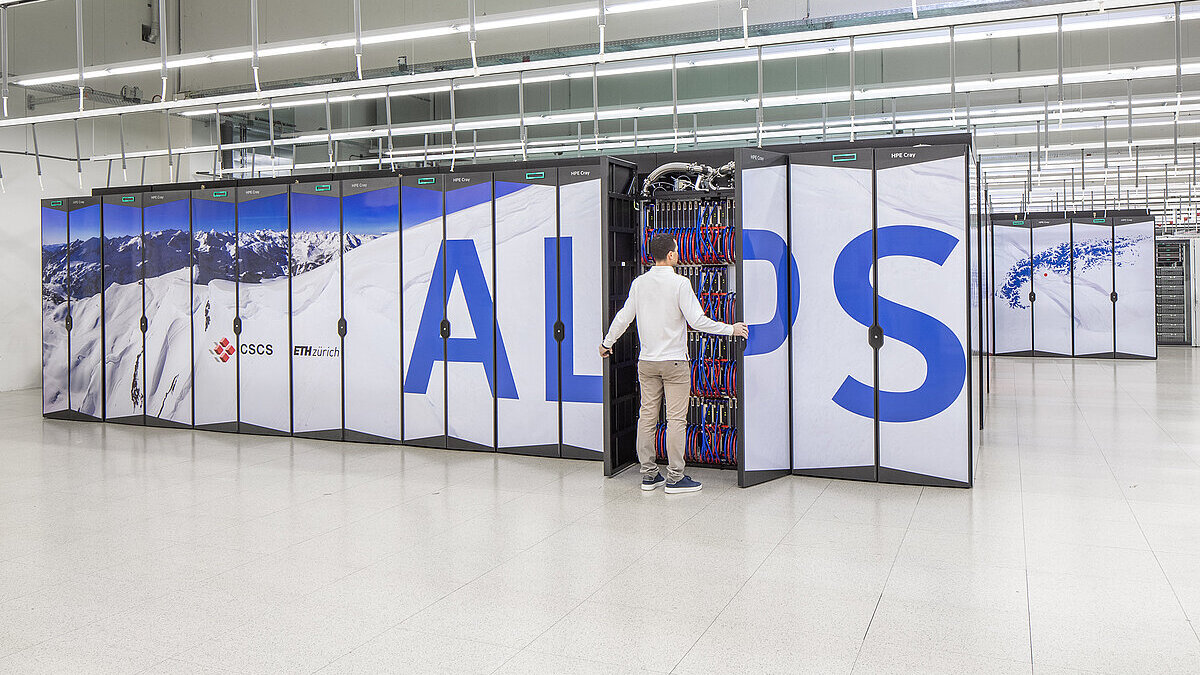
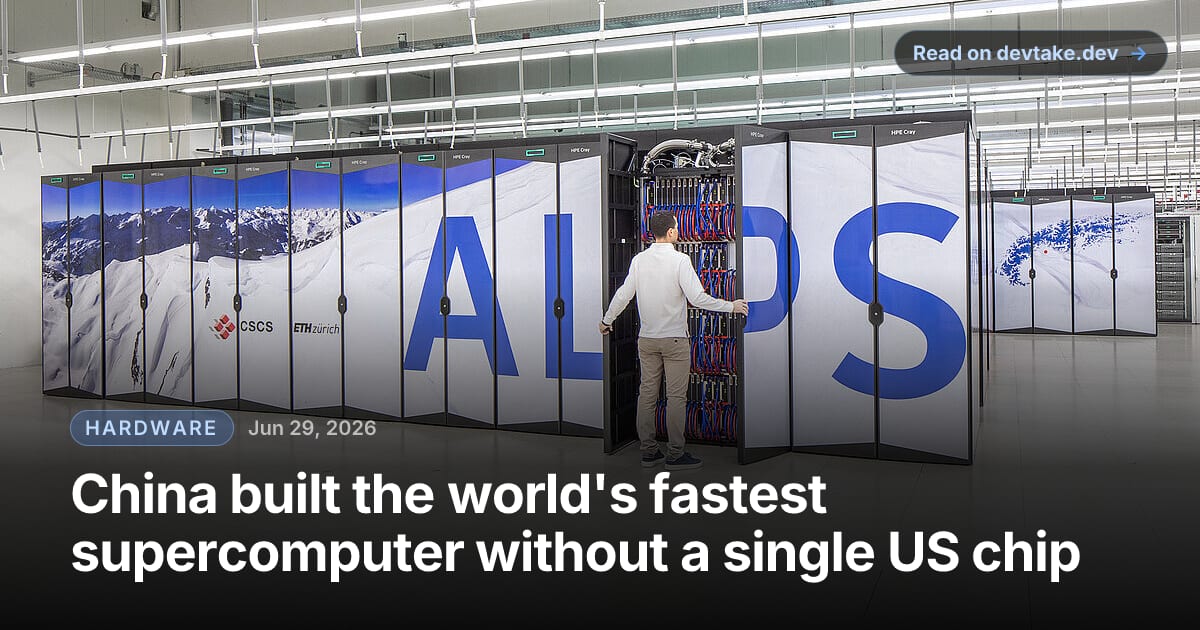
For the first time since 2017, the world’s fastest supercomputer is Chinese. A machine called LineShine debuted straight at No. 1 on the June 2026 TOP500 list at the ISC’26 conference in Hamburg, and it did it without a single American chip inside.
That last part is the story. The previous champion, El Capitan at Lawrence Livermore in California, runs on AMD silicon. LineShine runs on processors co-designed in China with Huawei, stitched together by a homegrown interconnect, booted on a domestic operating system. Years of US export controls were supposed to keep exactly this from happening. It happened anyway.
What the TOP500 actually measures
The TOP500 is a ranking, published twice a year since 1993, of the most powerful publicly known supercomputers on Earth. One number decides the order: the score on High Performance Linpack, usually shortened to Linpack. The benchmark hands the machine one enormous system of linear equations and times how fast it solves it in 64-bit precision. That’s it. Solve the math faster, rank higher.
The unit everyone quotes is the exaflop. One exaflop is a quintillion floating-point operations per second, which is a one followed by 18 zeros. “Exascale” just means crossing that line. The US reached it first with Frontier in 2022. LineShine’s reported Linpack score is 2.198 exaflops, the first time any system has cleared two sustained exaflops in 64-bit math, and more than 20% ahead of El Capitan’s 1.809. The machine sits at the National Supercomputing Centre in Shenzhen and was built by the Shenzhen Cloud Computing Center.
A word on the “China claims” framing you’ll see throughout. The TOP500 publishes whatever scores submitters send, and it relies on the operator to run the benchmark honestly. There’s no independent audit team that flies to Shenzhen to re-run Linpack on the hardware. The numbers are plausible and consistent across the list’s own secondary benchmarks, but they are not externally verified the way a peer-reviewed result would be. Treat the figures as reported, not proven.
How China got here without Western chips
The design choice that makes LineShine unusual is the absence of GPUs. Almost every leading supercomputer of the last decade leans on graphics chips from Nvidia or AMD to do the heavy lifting, because GPUs crunch parallel math far faster per watt than general-purpose processors. LineShine skips them entirely. It’s an all-CPU machine, the first ever to pass two exaflops on processors alone.
The processors are the part that matters for the export-control angle. LineShine uses 40,960 custom “LX2” chips, each with 304 cores running at 1.55 GHz, built around the Armv9 instruction set and co-designed with Huawei. They sit in Huawei Kunpeng server racks. The system’s nodes talk to each other over a proprietary “LingQi” interconnect pushing 1.6 terabits per second per node, and the whole thing boots Kylin OS, a domestic Linux variant from China’s National University of Defense Technology. Add it up and you get 13,789,440 cores drawing 42.2 megawatts.
The one Western thread is Arm. The LX2 cores are built on the Armv9 architecture, designed in the UK and licensed worldwide. That’s an instruction set, the rulebook a chip’s cores follow, not a physical chip you import. China can license the design and fabricate the silicon at home, which is precisely why an Arm-based path sidesteps the controls aimed at finished US chips.
Why did this surface only now? China stopped submitting systems to the TOP500 around 2023, after the first wave of US export restrictions made publicizing domestic supercomputers politically awkward. A machine this large almost certainly existed in some form before its public debut. Showing up at ISC’26 with a No. 1 entry, after years of silence, reads as a deliberate statement: the controls didn’t stop us, and we want you to know.
Whether the export-control strategy is working
The US export rules on advanced chips, run by the BIS and enforced through the Entity List, were designed to deny China the leading-edge silicon that powers frontier compute. The line is drawn partly using a metric called total processing performance, which gates which chips need a hard-to-get license. The bet behind the policy: starve China of the best Nvidia GPUs and the most advanced fabrication, and its supercomputing and AI ambitions stall.
LineShine complicates that bet without demolishing it. Jack Dongarra, the emeritus professor who helped create the Linpack benchmark and still organizes the list, put the tension plainly. “Export controls may slow China’s access to certain advanced components, but they also provide a strong incentive to develop domestic alternatives,” he told Al Jazeera, adding that the controls “may both constrain China and accelerate its efforts to become technologically self-sufficient.” A policy meant to create dependence has, at least in this corner, taught China to build alone.
But the win is narrower than “fastest supercomputer” suggests, and this is the part the headline numbers bury. Linpack measures 64-bit precision math, the bread and butter of climate models, fluid dynamics, and nuclear simulation. Modern AI training runs on much lower precision. On HPL-MxP, the mixed-precision benchmark that tracks AI-style workloads far more closely, LineShine ranked only fourth at 7.92 exaflops. An all-CPU machine is a monster at classic science and a poor fit for the GPU-shaped math that trains large language models. So the headline crown sits squarely in the domain the export controls care least about, while the AI-relevant compute, the actual target of the policy, is where China still trails.
That nuance shows up in the analyst read too. The US “still leads globally in terms of technology, but the gap is not wide,” Addison Snell of Intersect360 Research told Al Jazeera, framing the contest increasingly around “digital sovereignty,” each bloc wanting a compute stack it fully owns. Nvidia, for its part, still powers over 400 of the 500 systems on the list, a reminder of how much of global HPC remains American-shaped even on the day a Chinese machine took the top slot.
This isn’t China’s first time at No. 1. Sunway TaihuLight held the crown in 2017, also on domestic chips, before falling behind as US machines reached exascale. The pattern matters: China has repeatedly shown it can build a record-setting machine when it decides to, and export controls have shaped how, not whether. The open question is whether the same domestic stack can be bent toward AI training, where the precision profile and the chip economics are completely different.
What this means for you
If you follow the chip-war story, LineShine is the clearest evidence yet that export controls are a speed bump, not a wall, at least for state-funded mega-projects with unlimited motivation to engineer around them. But don’t read it as “the controls failed.” The crown sits on a 64-bit science benchmark, the one corner of compute the policy was never really aimed at, while on the AI-relevant measure China still ranks fourth. The honest takeaway is messier than either triumph or vindication: the controls are pushing China to build a parallel, self-owned compute stack faster than it otherwise would have, and that stack is excellent at classic supercomputing and not yet competitive at frontier AI. Watch the HPL-MxP column on the next two lists. If a Chinese all-domestic system climbs that ranking the way LineShine climbed the main one, that’s the moment the export-control debate genuinely changes.
Share this article
Quick reference
- export controls
- US rules that restrict shipping certain goods, software, and technology abroad. Sales to restricted parties need a BIS license that's usually denied.
- BIS
- Bureau of Industry and Security, the Commerce Department arm that runs US export controls and decides who lands on the Entity List.
Sources
- LineShine: All-CPU Chinese supercomputer named world's most powerful — DatacenterDynamics
- China takes US crown for world's fastest supercomputer — Al Jazeera
- China built the world's most powerful supercomputer using Huawei chips and no GPUs — TechSpot
- TOP500 List — TOP500.org
Frequently Asked
- What is the TOP500 list?
- A twice-yearly ranking of the world's most powerful publicly known supercomputers, ordered by a single benchmark called High Performance Linpack. It has been published since 1993 and is announced at the ISC and SC conferences.
- What does the Linpack benchmark actually measure?
- Linpack times how fast a machine solves one giant system of linear equations in 64-bit precision. It rewards raw, sustained number-crunching, which is why it became the standard yardstick for scientific computing.
- What is an exaflop?
- One exaflop is a quintillion (a billion billion) floating-point math operations per second. LineShine's 2.198 exaflops means it sustains roughly 2.2 quintillion calculations every second on the Linpack test.
- Did LineShine really avoid all US chips?
- It uses no Nvidia or AMD accelerators and no US-made CPUs. The one Western link is the Armv9 instruction set, designed in the UK by Arm, which the LX2 processors are built around. Everything else is reported as domestic.
- Is LineShine also the best for AI work?
- No. On HPL-MxP, the mixed-precision benchmark that tracks AI-style math more closely, LineShine ranked fourth. Its all-CPU design wins on classic 64-bit science but isn't built for the low-precision workloads modern AI training leans on.