OpenAI built its own AI chip with Broadcom. The target is Nvidia's inference margins.
Jalapeño is OpenAI's first custom inference processor, co-designed with Broadcom. Here's what a purpose-built inference ASIC actually buys you, and who else is doing it.

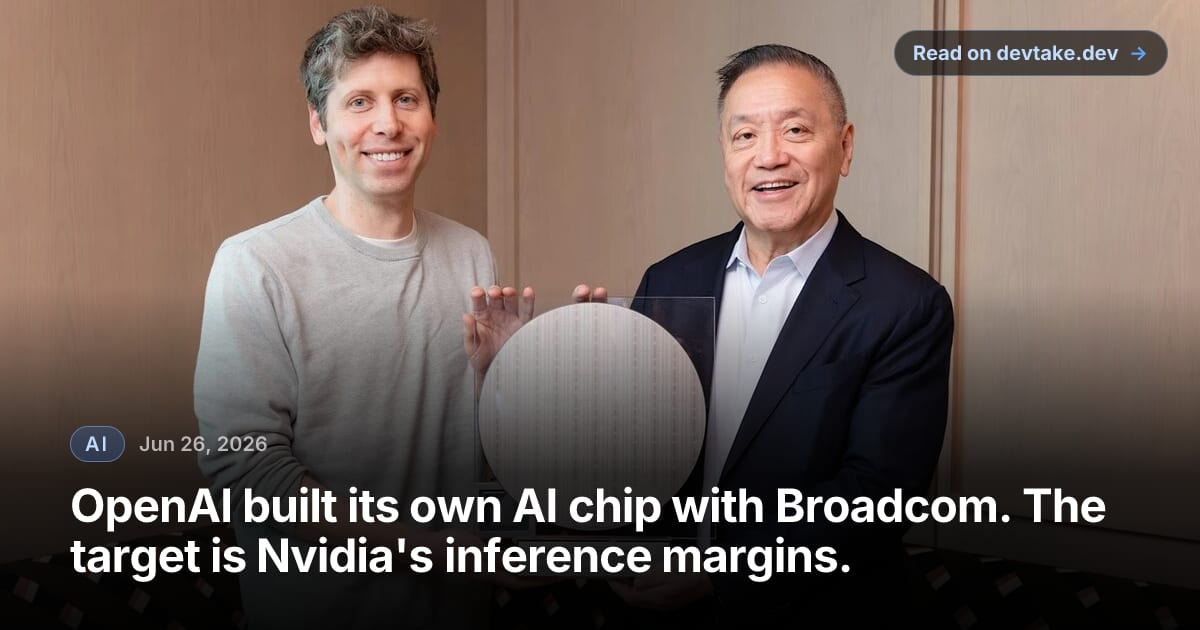
Sam Altman spent June 24 holding a chip on a couch next to Broadcom’s CEO. The chip is called Jalapeño, and it’s the first piece of silicon OpenAI has ever designed itself. Co-built with Broadcom, it does exactly one thing: run OpenAI’s models for the millions of people typing into ChatGPT and Codex every day. Not train them. Run them.
That distinction is the whole story. Every AI company today rents or buys Nvidia GPUs to do both jobs, and pays Nvidia’s roughly 70% gross margin for the privilege. Jalapeño is OpenAI’s attempt to claw some of that money back on the part of the workload that never sleeps. OpenAI calls it the first accelerator in a “multi-generation compute platform” the two companies are building together, with first deployment by the end of 2026 at gigawatt scale. Below is what that actually means, and why nearly every large AI company is now drawing its own chips.
What a custom inference chip actually is
A GPU is a generalist. Nvidia’s H100 and Blackwell parts can train a frontier model, render graphics, run a physics sim, or serve a chatbot, because they’re programmable for almost anything. That flexibility costs silicon area and watts. An ASIC throws the flexibility away. It bakes one workload into the transistors and optimizes everything else around it.
Jalapeño is a purpose-built inference chip, which OpenAI is careful to say is “not a repurposed training accelerator or a general-purpose AI processor.” Training is the one-time job of building a model. Inference is the forever job of running it. When you send a prompt, a cluster of chips reads the model’s weights out of memory, does a wall of matrix math, and streams back tokens. Do that a few billion times a day and the inference bill dwarfs the training bill. So the chip you tune for it is the one that moves your unit economics.
OpenAI’s hardware lead Richard Ho framed the design goal plainly: Jalapeño should “efficiently execute our most important workloads close to the hardware’s theoretical limits,” as he told Interesting Engineering. The architecture leans on cutting data movement and balancing compute, memory, and networking so the chip runs near its peak instead of stalling. Reduce the gap between theoretical and real-world throughput and you serve more tokens per watt, which is the same as saying each answer costs less.
Why OpenAI is doing this now
Three numbers explain the timing: cost, control, and capacity.
Start with cost-per-token, the metric that decides whether an AI product makes money. A fixed-function inference chip can serve a given model cheaper than a flexible GPU because it isn’t paying for hardware it never uses. Early testing, per OpenAI, shows Jalapeño delivers performance per watt “substantially better than current state-of-the-art.” That’s a vendor claim with no public benchmark behind it yet, so treat the magnitude as unproven. But the direction is real and the precedent is solid: Google’s TPUs already run inference at 50% to 70% lower cost per token than comparable Nvidia parts in published comparisons. OpenAI wants that curve for itself.
Then there’s control. OpenAI is trying to own the full stack, from the chip up through the model. CNBC reported that the company framed the announcement as part of an effort to “build the full stack” behind its products. When you design the chip, you can co-design it with the model, the scheduler, and the networking instead of bending all of those to fit someone else’s hardware roadmap. OpenAI even used its own models to speed up parts of the chip design, and says the program went from initial design to tape-out in nine months, which it calls the fastest ASIC cycle ever for a high-performance semiconductor. Engineering samples are already running GPT-5.3-Codex-Spark in the lab at production power and frequency.
Capacity is the quiet third reason. There are only so many Nvidia GPUs in the world, and OpenAI competes with Microsoft, Meta, Anthropic, and everyone else for them. Designing its own chips, deployed at gigawatt scale starting in 2026, gives OpenAI a supply line it controls. That fits the broader spending wave we covered in the hyperscaler AI capex story: the money going into compute in 2026 is enormous, and chips you design yourself stretch each dollar further than chips you rent.
Where Broadcom fits, and the rest of the chip war
OpenAI designs the accelerator. Broadcom turns the design into manufacturable silicon and wires the chips together. Broadcom’s HBM interfaces, packaging, and its Tomahawk networking platform handle the part that’s arguably harder than the chip itself: getting thousands of accelerators to talk to each other fast enough to act like one giant computer. Broadcom CEO Hock Tan called the partnership “a fundamental commitment to scaling the physical infrastructure required for the next decade of AI.” That’s CEO-speak, but it points at something true: at gigawatt scale, the network between chips matters as much as the chips.
This is the same playbook Broadcom already runs with other giants, and OpenAI is the latest name on a long list. Google has shipped TPUs since 2016 and is now on its seventh generation, the kind of multi-year head start on display in our TPU Ironwood launch story. Amazon has Trainium 3, which it says matches Nvidia’s Blackwell at rack scale for roughly half the total cost of ownership. Meta has MTIA, Microsoft has Maia, and even startups are chasing the same idea, as Qualcomm’s reported bid for the RISC-V chip designer Tenstorrent shows.
The pattern is unmistakable. Custom AI-chip shipments are growing 44.6% in 2026 versus 16.1% for merchant GPUs, the first year ASICs meaningfully outpace GPU growth. Nvidia still owns training and still sells more AI silicon than anyone. But inference is the bigger long-run market, and it’s the one the hyperscalers are quietly walling off with their own chips.
The caveats worth keeping
A few things should temper the hype. First, OpenAI hasn’t published a single benchmark. “Substantially better performance per watt” is a press-release phrase until there’s a number next to a named competitor on a named model. A few outlets have run with a figure of roughly 50% cheaper inference, but that’s a publication’s framing, not a number OpenAI stood behind, so don’t bank on it.
Second, custom silicon is a long game. Google needed multiple TPU generations before the chips were genuinely competitive for outside workloads. A first-generation chip that ships in late 2026 will spend a year or two maturing. Jalapeño is the start of a roadmap, not a finished product line.
Third, this doesn’t kill Nvidia. OpenAI keeps buying Nvidia for training and keeps a separate AMD supply deal alive. Jalapeño narrows Nvidia’s share of one workload at one customer. That’s meaningful at OpenAI’s scale, but Nvidia’s training near-monopoly and its software moat aren’t going anywhere this year.
What this means for you
If you build on the OpenAI API, the practical upside is downstream and slow: cheaper inference for OpenAI tends to show up as cheaper or faster API calls over time, not as a price cut next week. Don’t rearchitect anything around a chip that isn’t deployed yet. If you’re picking an inference platform today, the real lesson is broader than one chip. The whole industry is shifting toward purpose-built inference silicon, which is why Google’s TPUs and Amazon’s Trainium are now worth pricing against Nvidia when you choose where to run a model, not just defaulting to GPUs out of habit. Watch the back half of 2026 for OpenAI’s first real benchmark. If Jalapeño’s performance-per-watt claim survives contact with an independent test, the cost of serving large models drops for everyone, because it proves the GPU tax was optional all along.
Share this article
Quick reference
Sources
- OpenAI and Broadcom introduce an LLM-optimized inference chip — OpenAI
- OpenAI and Broadcom announce an LLM-optimized Intelligence Processor — Broadcom
- OpenAI introduces the Jalapeño chip for large-scale inference workloads — Interesting Engineering
- OpenAI's first custom AI inference chip, Jalapeño, built with Broadcom — VentureBeat
- OpenAI reveals its first chip in a Broadcom deal to 'build the full stack' — CNBC
Frequently Asked
- What is an inference chip, and how is it different from a training chip?
- Training builds a model by chewing through huge datasets once. Inference runs the finished model every time someone sends a prompt. Inference is the bill that never stops, so a chip tuned only for it can drop the cost of each answer.
- Is Jalapeño meant to replace Nvidia GPUs at OpenAI?
- Not entirely. OpenAI keeps buying Nvidia and AMD GPUs for training and for general work. Jalapeño targets the highest-volume inference, where a fixed-function chip can be cheaper per token than a flexible GPU.
- Can developers buy a Jalapeño chip?
- No. It's internal silicon OpenAI runs in its own data centers to serve ChatGPT, Codex, and the API. You'd feel it as cheaper or faster API responses, not as hardware you rack yourself.
- Who else builds custom AI chips like this?
- Google has shipped TPUs for years and is now on its seventh generation. Amazon has Trainium, Meta has MTIA, and Microsoft has Maia. Broadcom co-designs several of these, which is why it keeps showing up in the chip war.