Nvidia wants to own every chip inside the AI data center
Nvidia already dominates AI GPUs. Now it's pushing to supply the CPU, the network, and the whole rack. Here's who that squeezes and whether buyers benefit.
Nvidia already sells the vast majority of the world’s AI accelerators. Jensen Huang wants the rest of the rack too. A recent report from Runtime lays out the ambition in Huang’s own words: “We are a vertically integrated computing company. There is no other way.”
That line is the whole strategy in nine words. Nvidia isn’t content being the GPU vendor everyone has to call. It’s building toward a world where the processor, the network card, the switch, the interconnect, and the sheet-metal rack all carry its logo, and where swapping any one piece for a rival’s part quietly breaks something. For anyone buying AI compute over the next three years, this shapes what you can mix, what you’ll pay, and how locked in you end up.
Owning the whole rack
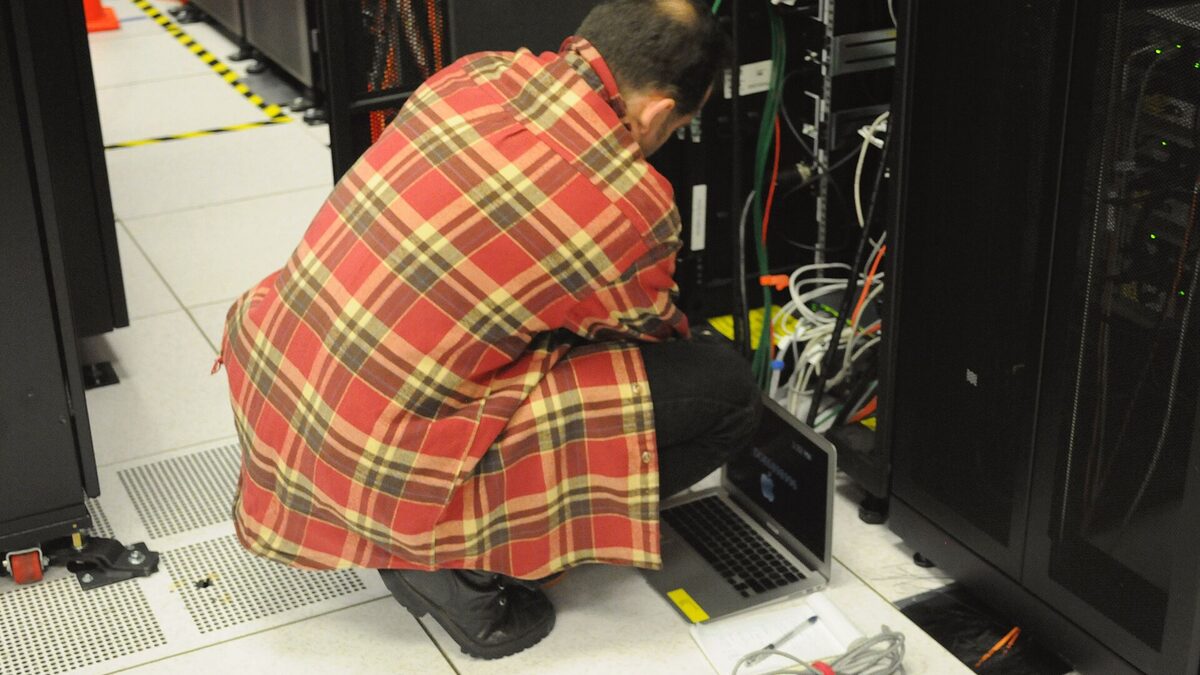
Start with what “the rack” actually contains. A modern AI server isn’t one chip. It’s GPUs doing the math, a CPU orchestrating them, a DPU shuffling data and handling security, high-speed interconnect wiring the GPUs together, and a switch fabric linking racks into a cluster. Nvidia now makes a product for every one of those slots.
The Grace CPU is its Arm-based answer to Intel and AMD server chips. BlueField covers the DPU tier. NVLink is the interconnect that lets dozens of GPUs behave like one, and Spectrum-X is its Ethernet networking line. Wrap it together and you get the NVL rack systems, where Nvidia ships a finished, cabled, liquid-cooled cabinet instead of loose parts. The next-generation Vera Rubin platform, due in the second half of 2026, reportedly bundles seven distinct chip types, including a Vera CPU and a Rubin GPU designed to work as a unit.
Huang’s framing is Apple’s playbook aimed at the data center. Own the silicon and the software, tune them to each other, and sell the integration as the product. The CUDA software layer is the glue: code written for Nvidia GPUs runs best on Nvidia everything, and each additional Nvidia component tightens that fit. Nvidia booked $216 billion in revenue in FY2026, up from $27 billion three years earlier. The GPU got it here. The rack is how it plans to stay.
Who Nvidia squeezes
Every slot Nvidia fills is a slot someone else used to own. On CPUs, that’s Intel and AMD, whose Xeon and EPYC parts have long been the default host processor next to an accelerator. Grace turns that host into an Nvidia part too.
Networking is the sharper fight. Broadcom commands roughly 80% of the Ethernet switching ASIC market, and its chips paired with Arista’s software have become a serious “Ethernet bloc” inside AI clusters. Marvell is the other custom-networking heavyweight. Nvidia’s Spectrum-X is playing catch-up here, which is why the company’s move was as much about co-opting rivals as beating them.
Rack-scale is the third pressure point, and the quietest one. When Nvidia sells a finished NVL cabinet, it also captures the system integrators and OEMs like Dell, Supermicro, and HPE that used to add their own value by assembling the box. Buy the whole rack and there’s less left for anyone else to build.
Then there are the hyperscalers, the biggest customers and the most dangerous competitors. Roughly 60% of Nvidia’s revenue comes from five cloud giants that are all designing their own chips. Nvidia depends on the exact companies with the strongest reason to need it less. Google, Amazon, Microsoft, and Meta each spend billions a year to shave Nvidia parts out of their fleets wherever the workload is predictable enough to justify a custom design.
The counter-moves are real
None of these players is standing still. Google has run its own TPU accelerators for years at margins Nvidia can’t match on its own hardware. Meta has expanded its MTIA line across the 300, 400, and 500 series to run recommendations and generative features. Amazon announced Trainium4 in December 2025 for late-2026 availability, promising three times the FP8 throughput of the prior generation, per Tom’s Hardware.
OpenAI joined the club too. Its first custom inference chip, built with Broadcom, targets 10 gigawatts of deployed capacity by 2029, and we covered the details in our piece on the Jalapeño chip. AMD’s MI-series remains the closest thing to a drop-in GPU alternative, and Broadcom and Marvell together run a fast-growing business designing bespoke accelerators for whoever wants one. The numbers show the pressure: Nvidia still holds around 70% of the AI chip market, but custom-ASIC AI server shipments are projected to hit 27.8% of the market in 2026, growing nearly 45% year over year. Those chips don’t have to beat Nvidia on raw performance. They have to be good enough on a workload the buyer runs at scale, and cheaper to run.
Nvidia’s clever hedge is NVLink Fusion, a program that lets hyperscalers build their own accelerators while still plugging into Nvidia’s interconnect. The catch is the point: every NVLink Fusion platform must include at least one Nvidia component, whether a Vera CPU, a ConnectX card, a BlueField DPU, or a Spectrum-X switch. Build your own chip, sure. You’re still buying from Nvidia.
The power bill behind it all
Whoever wins the silicon fight, the electricity meter keeps spinning. A new BloombergNEF estimate projects data centers will consume one-fifth of all U.S. electricity by 2035, a fourfold jump from today. Capacity is headed toward nearly 200 gigawatts over the next decade, with about half of it dedicated to AI training and inference.
That forecast is itself 83% higher than what the same firm predicted in December, and it’s why the whole-rack pitch resonates. When power and cooling are the binding constraint, a vendor that hands you a pre-tuned, liquid-cooled cabinet with known thermals is selling time, not just chips. It also means Nvidia’s efficiency-per-watt claims stop being a spec-sheet footnote and start being the number that decides whether you can build the cluster at all. Cheap electrons are the real bottleneck now.
Owning more of the rack helps Nvidia here too. A CPU, DPU, and switch designed alongside the GPU can move data with fewer wasted watts than a bolted-together mix of parts from four vendors. That’s a real engineering argument, and it’s also a sales argument for buying everything from one company. Utilities are already the ones sweating the forecast: by 2033, BloombergNEF expects new data centers worldwide to add 1,935 terawatt-hours of demand, roughly what India uses in a year.
What this means for you
If you’re buying AI compute, the one-vendor rack is a genuine convenience and a genuine trap. Convenience, because integration is brutal and Nvidia’s finished cabinets ship faster and break less than parts you cable yourself. Trap, because every layer you buy from one company is a layer where that company sets the price and controls the roadmap. The reason you’re reading about this now is that two things landed in the same month: the report spelling out Huang’s whole-stack goal, and a power forecast that makes vendor efficiency claims load-bearing.
My read: treat the full Nvidia rack as the fast path, not the only path. Keep a real second source in your plan, whether that’s AMD GPUs, a hyperscaler’s own accelerator, or Broadcom-based networking, even if you don’t deploy it yet. The moment Nvidia knows you can’t leave is the moment your renewal quote changes. Ask any hyperscaler why it’s spending billions to design its own chips, and you already have the answer.
Share this article
Sources
- Nvidia wants the whole AI data center — Runtime
- Data centers expected to use 4x more electricity by 2035 — TechCrunch
- Nvidia crowned AI networking's top dog, but its throne isn't quite safe — SDxCentral
- The custom AI ASIC state of play (May 2026) — Tom's Hardware
Frequently Asked
- What is vertical integration in the context of AI chips?
- It means one vendor supplies most of the components in a system instead of buying them from rivals. Nvidia is extending from GPUs into CPUs, networking, and rack-scale hardware so a full AI cluster can be mostly Nvidia parts running Nvidia software.
- Does Nvidia only sell GPUs?
- No. Nvidia sells the Grace CPU, BlueField DPUs, NVLink and Spectrum-X networking, and pre-built NVL rack systems. The GPU is still the flagship, but the company now markets the whole rack as one product.
- Who competes with Nvidia inside the data center?
- Intel and AMD on CPUs, Broadcom and Marvell on networking silicon, and hyperscalers like Google, Amazon, and Meta building their own accelerators. OpenAI is designing a custom inference chip with Broadcom.
- Is buying the whole rack from Nvidia good or bad for customers?
- It cuts integration headaches and usually ships faster, but it deepens lock-in and gives one vendor pricing power over your entire compute stack. Most large buyers are hedging with a second source.