Valve's Steam Machine starts at $1,049, not the $750 it planned. The RAM shortage ate the difference.
Valve's living-room console launches at $1,049 to $1,428. Here's what's inside, why the price ballooned, and how SteamOS lets you skip the hardware entirely.
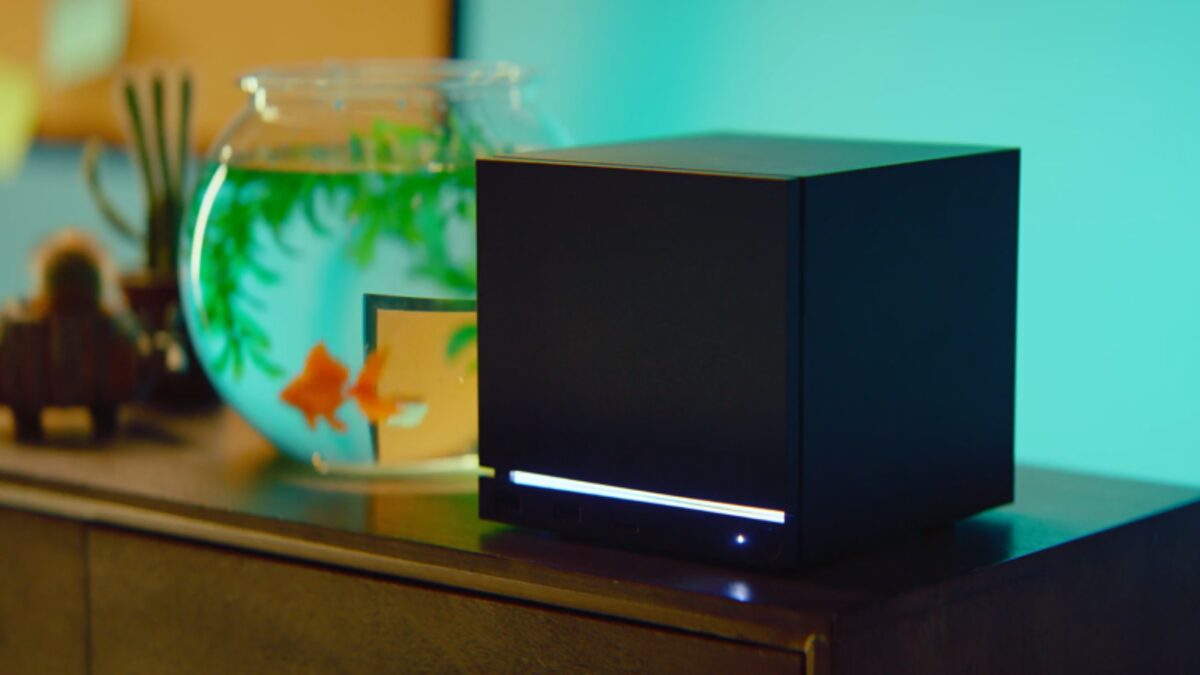
Valve’s Steam Machine is finally on sale, and it costs far more than anyone expected. The living-room console launched at $1,049 for the entry model, climbing to $1,428 for the top configuration. That’s not the $700-ish box gamers had penciled in.
The reason traces straight back to the memory shortage now inflating phones and laptops. Here’s the part Valve didn’t hide: the company says it wanted to charge far less, and the components market made that impossible. So before the specs, the price is the story, and it’s a warning about where consoles are headed. Valve first showed this hardware in November 2025 with no number attached, then went quiet for seven months. The wait, it turns out, was about the bill of materials, not the engineering.
What you actually get for $1,049
The Steam Machine is a small cube, roughly six inches on a side, that plugs into your TV and runs SteamOS, the same Linux-based console software that powers the Steam Deck. Think of it as a pre-built gaming PC that boots straight into a controller-friendly interface instead of a Windows desktop.
Inside is a semi-custom AMD setup: a six-core, twelve-thread Zen 4 CPU clocked up to 4.8 GHz, paired with a discrete RDNA 3 graphics chip carrying 28 compute units, 8GB of dedicated GDDR6 video memory, and a power budget up to 110 watts. There’s 16GB of system DDR5, Wi-Fi 6E, Bluetooth 5.3, gigabit Ethernet, and a spread of USB ports plus DisplayPort and HDMI out.
Valve’s headline claim is performance. The company says the Steam Machine delivers more than six times the graphics grunt of a Steam Deck, with a target of 4K at 60 frames per second in select titles when upscaling is turned on. In Valve’s own testing, Cyberpunk 2077 reportedly ran around 65 fps at 4K with ray tracing on medium settings. That lands it somewhere between a base PS5 and a PS5 Pro, depending on the game.
The four tiers, all confirmed by Valve: $1,049 for 512GB, $1,128 for 512GB with a Steam Controller, $1,349 for 2TB, and $1,428 for 2TB with the controller. Reservations run until June 25 at 10 a.m. Pacific, and purchase invitations go out the week of June 29.
Why the price ballooned
Valve was unusually blunt about this. The company paused its original 2026 launch window back in February and admitted the memory and storage shortage was forcing a full rethink. When the price finally landed, Valve explained why:
“Our original goal for the price of Steam Machine is no longer viable. The prices we’re sharing today reflect the state of the world for manufacturing; or, more accurately, it reflects the price of the components as we’ve secured them over the past 6 months.”
Valve engineers hinted the original target sat around $750. The gap between that figure and $1,049 is roughly a third, and it’s almost entirely memory. DRAM contract prices rose more than 170% year over year between Valve’s announcement and mid-2026 as AI data-center buildouts swallowed supply. Samsung and SK Hynix have steered fab capacity toward high-margin server memory, leaving the consumer DDR5 and storage that goes into a box like this both scarcer and pricier.
This is the same squeeze hitting the rest of consumer tech. We covered it when Apple flagged memory costs as a drag on its own hardware margins. The difference is that Valve put a hard number on what it did to a single product, and then shipped at the higher price rather than eating the cost or canceling. A console maker absorbing a 33% component spike without raising the sticker would be losing money on every unit, and Valve has been clear its hardware needs to stand on its own.
Timing made it worse. Valve secured most of its components over the six months before launch, exactly the window when contract DRAM and NAND prices were spiking hardest. A device announced a few months earlier, or shipped a year later, might have caught a calmer market. Valve caught the peak. That’s the danger of locking a fixed-price console into a volatile parts market: the manufacturer either pre-buys memory early and gambles on demand, or buys late and pays whatever the AI buildout has left behind. Neither option was kind this cycle.
You can skip the box entirely
The quiet headline for PC players: you don’t need the hardware at all. SteamOS, the operating system on the Steam Machine, also runs on a standard desktop PC. Install it on a rig you already own, or build one to your own budget, and you get the same console-style interface, Proton compatibility layer, and game library without paying Valve’s hardware premium.
That escape hatch matters more this year than usual. If a $1,049 prebuilt feels steep, a self-built machine with comparable specs sidesteps the memory markup baked into Valve’s bill of materials, because you choose when and what to buy. The trade-off is the usual one: you do the assembly, the driver wrangling, and the troubleshooting yourself, and you lose the quick-resume and verification niceties Valve tunes for its own box.
There’s a performance sweetener coming too. Valve confirmed it’s collaborating with AMD on the latest upscaling tech:
“We’ve been working with AMD on FSR 4 support for Steam Machine, and can confirm that it will be coming soon.”
FSR 4 is AMD’s machine-learning-driven FidelityFX Super Resolution, the frame-boosting upscaler that until recently was gated to newer RDNA 4 GPUs. Getting it running on the Steam Machine’s RDNA 3 silicon, through the Proton compatibility layer, is what lets Valve chase 4K targets on mid-range hardware. Datamining of Proton test builds suggests the same work could eventually reach older GPUs and even the Steam Deck, though Valve hasn’t promised that.
Consoles are getting expensive, and this is why
The bigger picture is the one worth sitting with. A four-figure console used to mean a niche enthusiast box. Now it’s the entry price for a mainstream living-room PC from the company that owns the storefront. The Verge framed the launch as the start of a more expensive future for game consoles, and the logic is hard to argue with. If memory stays this tight, the next round of hardware from Sony, Microsoft, and Nintendo faces the same math.
Gaming has already been bruised this year. Microsoft’s Xbox layoffs signaled a platform under cost pressure, and AI-driven component demand keeps reshaping what consumer gadgets cost. Valve’s launch is a clean datapoint: a company that genuinely wanted to ship cheap couldn’t, and said so out loud.
What this means for you
If you were waiting for the Steam Machine to be the affordable PS5 alternative, recalibrate. At $1,049 it’s competitive on performance but no longer cheap, and the price isn’t coming down while DRAM stays expensive. The smartest move for most people isn’t reflexively reserving the box. It’s running the numbers two ways: price the Steam Machine against an equivalent self-build running SteamOS, and against a discounted PS5 or PS5 Pro that does most of what you want today. If you value the plug-and-play console experience and want Valve’s library on your TV with no fuss, the box earns its keep. If you already have a capable PC, install SteamOS for free and pocket the difference. And if you can wait, watch memory prices: the next six months decide whether this is a temporary spike or the new normal for everything with a chip in it.
Share this article
Quick reference
Sources
- Steam Machine launches today! — Valve (Steam)
- Steam Machine Launches, Priced $1049 To $1428 USD — Phoronix
- Valve Steam Machine officially priced at $1049 for 512GB and $1428 for 2TB bundle — VideoCardz
- Valve confirms it's 'working with AMD on FSR 4 support for Steam Machine' — PC Gamer
- The Steam Machine was originally supposed to cost around $750 — TweakTown
- Valve waited 7 months to reveal the price of the Steam Machine — Moneywise
Frequently Asked
- How much does the Steam Machine cost?
- It starts at $1,049 for the 512GB model and runs to $1,428 for the 2TB version bundled with a Steam Controller. The two middle tiers are $1,128 and $1,349.
- Is the Steam Machine more powerful than a Steam Deck?
- Valve says it delivers more than six times the graphics performance of the Steam Deck, targeting 4K at 60 fps in select games with upscaling enabled.
- Do I have to buy the hardware to use SteamOS?
- No. SteamOS runs on a regular desktop PC, so you can install Valve's console software on hardware you already own or build yourself instead of buying the box.
- When can I buy one?
- Valve opened a reservation list that runs until June 25 at 10 a.m. Pacific. Purchase invitations start going out the week of June 29.