Valve's Steam Machine is back after 14 years, and reviewers are split on the price
Valve's Steam Machine is a tiny, silent SteamOS console that starts at $1,049. The hardware impresses, the value doesn't, and here's who should actually buy one.
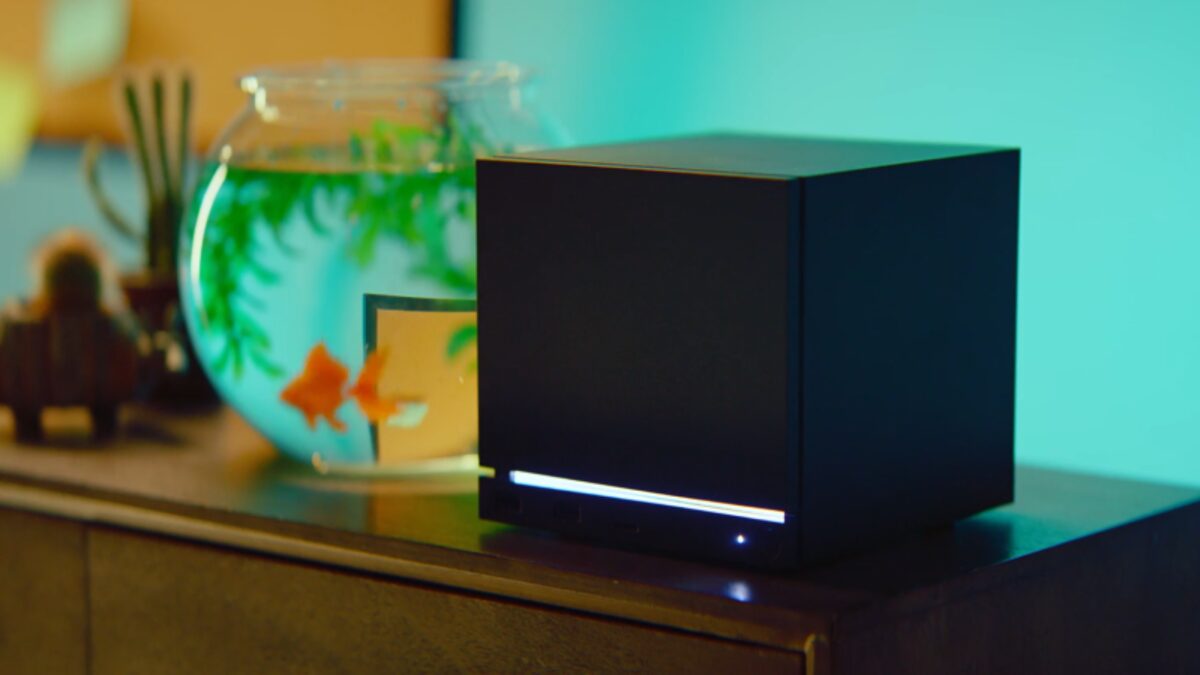
Valve is selling a living-room game console again, 14 years after its first attempt flopped. The new Steam Machine, a black cube that starts at $1,049, has been on sale since late June, and the early reviews are all over the map. Dave2D titled his “Bad News.”
That split is the whole story. Nearly every reviewer likes the box itself, a compact, near-silent machine that runs Valve’s SteamOS and plugs into the same enormous Steam library you already own. What they can’t agree on is whether it’s worth the money in a year when a similar amount buys a more powerful gaming PC or a pair of consoles. If you’ve watched the Steam Deck turn handheld PC gaming mainstream and wondered whether the same magic works under the TV, here’s what Valve actually built and who it’s for.
What Valve actually shipped
The Steam Machine is a roughly six-inch black cube with a glowing LED bar across the front and magnetic faceplates you can swap. Inside is a semi-custom AMD chip: a six-core Zen 4 CPU and an RDNA 3 graphics part with 28 graphics cores, paired with 16GB of DDR5 system memory and a separate 8GB of GDDR6 video memory, per the specs Valve published. Storage comes in 512GB or 2TB. Valve says the whole package lands at about six times the horsepower of a Steam Deck.
The target is 4K at 60 frames per second, but with a catch: it leans hard on FSR, AMD’s upscaling tech, to get there from a lower internal resolution. Native 4K on demanding games isn’t the pitch.
The software is where the story really lives. The machine runs SteamOS, the Linux-based system Valve refined on the Steam Deck, and it plays Windows games through Proton, Valve’s translation layer. No Windows license, no desktop clutter, just the Steam Big Picture interface on your couch. Pricing runs from $1,049 for the 512GB model up to $1,428 for the 2TB version bundled with the new Steam Controller, according to Valve’s own listing. Valve has also said FSR 4, a newer and sharper version of the upscaler, is coming to the machine through an ongoing collaboration with AMD, so the frame-rate story should improve after launch rather than stand still.
Why Valve is trying again
The first Steam Machines, a lineup of third-party boxes that shipped in 2015, sold poorly and quietly vanished. So why walk back into the room? The short answer is that the ground shifted underneath the idea.
Bloomberg’s Jason Schreier reported that the project traces back to 2012, when Valve started worrying about the future of Windows as a gaming platform and began building a Linux alternative. That work became SteamOS and Proton, and it sat mostly unused until the Steam Deck shipped in 2022 and proved millions of people would happily play Windows games on Linux without knowing or caring. The handheld did the hard part: it made SteamOS boring, in the good sense. Games just run.
The new Steam Machine is Valve extending that proven software onto a box that sits under the TV instead of in your hands. Schreier’s reporting also punctures the usual conspiracy theory: Valve never planned to hold Half-Life 3 hostage as a Steam Machine exclusive to force sales, and the company says it isn’t trying to out-ship PlayStation or Xbox at all. The goal is to grow SteamOS, not to win a console war. That framing matters, because it explains why Valve seems comfortable with a product reviewers are lukewarm on.
The reviews, and the bad news
Here’s where the enthusiasm meets the price tag. Dave2D titled his review “Bad News”, and the bad news is almost entirely about value. He praised the cooling, the near-silent operation, the swappable plates, and the fact that the controller’s wireless receiver is built in so there’s no dongle to lose. Then he pointed out the base model costs $1,049, well above the roughly $700 he’d guessed, and that 8GB of video memory is the bare minimum for a machine meant to last years.
Engadget scored it 6.5 out of 10 and summed the problem up in a headline: “This would’ve been perfect five years ago.” Their reviewer clocked Black Myth: Wukong at a 43fps average at 1080p on high settings, and found Cyberpunk 2077 falling short of 60fps at 1080p ultra without tuning. The verdict was blunt: the Steam Machine “isn’t worth the price that Valve is asking.” Praise for how quiet and well-built it is, frustration that the performance sits closer to an entry-level current console than to the gaming PC its price implies.
There’s a second catch that has nothing to do with the hardware: you may not be able to buy one. Valve launched the machine through a queue and a randomized draw rather than open sales, and Dave2D noted that units ordered now can slip to the end of the year or beyond. A device you can’t actually get is hard to recommend at any price.
The pattern repeats across outlets. Great little box. Hard-to-justify price. And because the CPU and GPU are soldered together as one chip, you can’t upgrade the graphics later the way a desktop owner can, so whatever you buy is what you’re stuck with.
Who should actually buy one
Start by ruling yourself out. If you already own a gaming PC, the Steam Machine offers you nothing you don’t have. If you own a Steam Deck, a $60 dock already throws your games on the TV at lower settings. That’s the math most enthusiasts are running, and they’re landing where the reviewers did.
“If you own one of them, steam machine is not worth it,” one long-time Deck and PC owner wrote on r/SteamDeck after comparing all three side by side, though they added that the controller is genuinely great. Not everyone agrees the price kills it. Plenty of Deck owners see the machine as Valve seeding a new category, the way the Deck itself dragged handheld PCs into the mainstream.
So who’s it for? The person who wants a first, tiny, silent SteamOS box under the television, doesn’t want to build or maintain a Windows PC, and values the couch experience over raw frames per second. For them, the Steam Machine is a clean appliance that plays a huge back catalog. For a shopper cross-shopping a PS5 Pro or a mid-range gaming PC on pure performance, it’s a tougher sell.
What this means for you
Don’t buy the Steam Machine as a spec sheet. Buy it as an appliance, or skip it. If frames per second per dollar is your metric, a self-built PC or a current console wins, and the reviews back that up. The Steam Machine’s real value is the thing that doesn’t show up in a benchmark: SteamOS on your TV with zero fuss, no Windows to babysit, and your whole library one click away.
My read: wait unless you specifically want that living-room-appliance experience and have no PC to dock a Deck to. The more interesting outcome isn’t this box’s sales, which Valve says it isn’t chasing anyway. It’s whether SteamOS keeps spreading to hardware Valve doesn’t make. That’s the bet worth watching over the next year, not the cube.
Share this article
Quick reference
Sources
- Steam Machine (official product page) — Valve (Steam)
- Valve's 14-Year Journey to Make the Steam Machine — Bloomberg
- Steam Machine Review - Bad News — Dave2D
- Valve Steam Machine review: This would've been perfect five years ago — Engadget
- Steam Machine release date, specs, and price — PCGamesN
Frequently Asked
- How much does the Steam Machine cost?
- It starts at $1,049 for the 512GB model with no controller, and runs up to $1,428 for the 2TB model bundled with a Steam Controller. A Steam Controller on its own adds about $79.
- Is the Steam Machine more powerful than a PS5 or Xbox Series X?
- Valve pegs it at roughly six times a Steam Deck, which is a big jump. But reviewers rate its raw power near an entry-level current console, and it falls short of a PS5 Pro or Series X in the most demanding games without heavy upscaling.
- Do I have to buy the box to get SteamOS?
- No. SteamOS is free and runs on many desktop PCs and rival handhelds, so you can get the same living-room interface without Valve's hardware if you already have a machine.
- Can I upgrade the Steam Machine later?
- The storage is user-accessible, but the CPU and GPU are a single soldered AMD chip. You can't drop in a new graphics card in two years the way you can with a desktop tower.
- Should I buy one?
- If you already own a gaming PC or dock your Steam Deck to the TV, probably not. If you want your first small, quiet SteamOS box under the television and don't want to build a PC, it makes more sense.