AMD's data center revenue jumped 57% to $5.8 billion in Q1. Its stock closed up 18%.
AMD reported Q1 revenue of $10.25B, up 38% YoY. Data center hit $5.8B (+57%) and Q2 guidance midpoint of $11.2B beat consensus by roughly $700M.
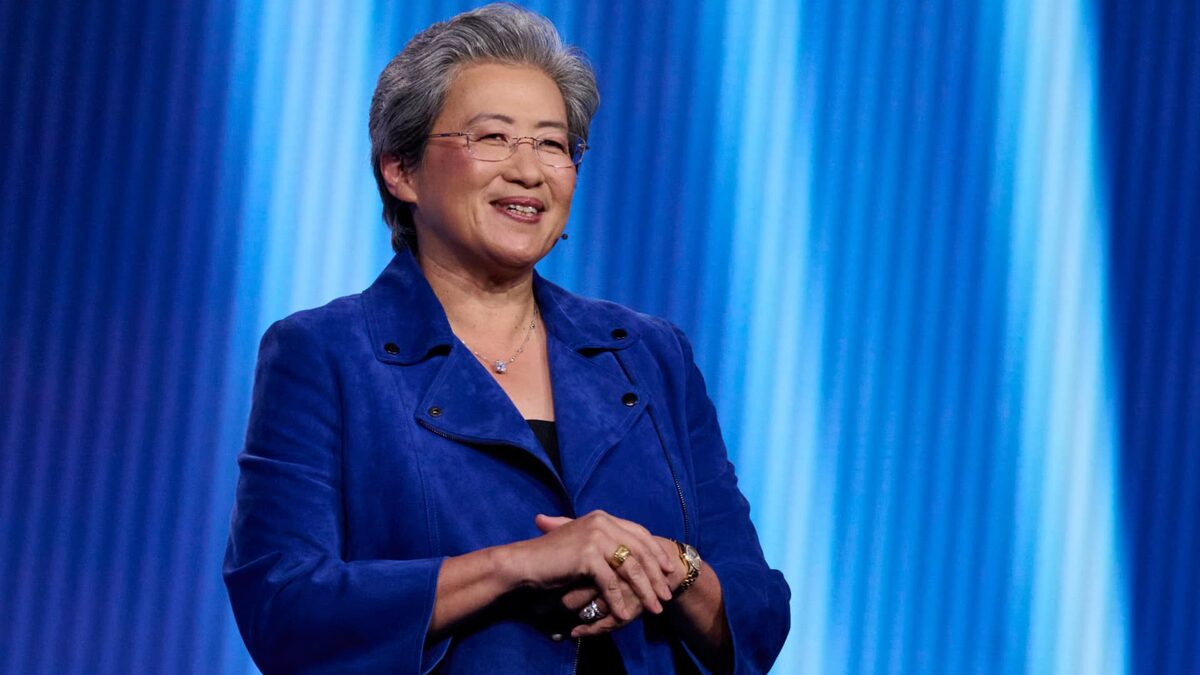
AMD posted Q1 2026 revenue of $10.25 billion on Tuesday, up 38% year over year. The data center segment alone landed at $5.8 billion, up 57%. The stock closed up 18% on Wednesday and pulled the rest of the AI chip group with it.
CEO Lisa Su called the data center unit “the primary driver of our revenue and earnings growth” on the call, and said AMD has “strong and increasing confidence” in reaching tens of billions of dollars in data center AI revenue next year. She also doubled the long-term server CPU total addressable market forecast to more than $120 billion by 2030, citing inference and agentic AI workloads as the structural reason CPU demand keeps climbing alongside the GPU build-out.
The print is the cleanest argument yet that there’s a second real buyer in the AI accelerator market, not just Nvidia plus a long tail of also-rans. AMD’s MI-series guidance and the Helios rack-scale system, which Yahoo Finance benchmarked against Nvidia’s NVL72, put it in direct contention for hyperscaler training builds.
What we know
The full Q1 segment breakdown, per CNBC:
- Data center: $5.8 billion, up 57% year over year. Beat the $5.6 billion analyst expectation. The MI-series accelerator pipeline and EPYC server CPU shipments did the heavy lifting.
- Client: $2.9 billion, ahead of $2.73 billion forecast. Ryzen demand for AI-PC SKUs and the share gain against Intel on enterprise refreshes.
- Gaming: $720 million, ahead of $668 million forecast. Console royalties and Radeon discrete sales.
- Embedded: roughly $0.85 billion, broadly in line. The smallest segment but the steadiest margin profile.
Q2 guidance is the load-bearing number. AMD is calling for revenue between $10.9 billion and $11.5 billion against a $10.52 billion consensus, per Reuters. Server CPU revenue is guided to grow more than 70% year over year in Q2, which is the kind of number that only makes sense if a major hyperscaler refresh cycle is locked in.
The Meta angle showed up in the earnings call. AMD pre-announced a 6-gigawatt deal with Meta earlier in the quarter, and the Q2 guidance bakes in the first wave of those shipments. Meta is the customer story most directly responsible for the data center number running 25 percentage points ahead of where it was a year ago.
What we don’t know
Margin durability. The 18% stock pop reflects revenue and guidance, not gross-margin trajectory. AMD’s data center accelerators sell at a structurally lower margin than Nvidia’s, and the MI-series ramp into hyperscaler racks is happening alongside aggressive pricing to win share. The Q1 GAAP gross margin number wasn’t on the front page of any of the wire reports we saw, which usually means the read-through is mixed.
Customer concentration. The Meta deal and the previously announced OpenAI accelerator commitment are doing a lot of the forward-looking growth math. AMD hasn’t disclosed how concentrated the data center book of business is, and a single customer push-out would visibly dent the H2 trajectory.
Competition timing. Nvidia’s GB300 ramp is supposed to land in Q3, and the MI series has to land its current generation into customer hands before that comparison gets made head-to-head. AMD’s roadmap implies a follow-on accelerator timed against GB300, but the launch date hasn’t been set publicly.
The market reaction
HSBC downgraded AMD to Hold on May 4, citing the 77% year-to-date rally and saying the AI chip trade looked stretched. That call aged a single trading day. Morgan Stanley took the other side on Wednesday and lifted its AMD outlook.
The broader chip group followed. Samsung crossed a $1 trillion market cap on the same day, pushed by AI memory demand and the AMD signal. Arm raised its full-year revenue outlook overnight, citing $2 billion in projected sales of its new AI-centric IP from 2027. The “AI chip rally” framing in the financial press is real, but the underlying signal is narrower than the framing suggests: it’s specifically the customers building hyperscaler AI clusters who are spending, and the suppliers downstream of those clusters who are getting paid.
What this means for you
If you’re a developer building on AMD ROCm, the Q1 data center number is the strongest signal yet that the platform finally has the customer base behind it to fund tooling. ROCm’s biggest historical weakness has been the gap between what Nvidia ships in CUDA and what AMD ships in ROCm. A 57% data center growth rate funds engineers, fast.
If you architect AI infrastructure, the Helios and MI roadmap now gives you a credible second-source story for training. That doesn’t translate to “swap in tomorrow,” but it does shift the negotiating power with Nvidia for the next purchase cycle. Hyperscalers were already telling Nvidia they wanted alternatives; AMD’s print is the proof point those conversations were waiting for.
If you watch chip stocks (without acting on this as advice), the rally has now run twice as fast as the underlying earnings revisions. HSBC’s “out of steam” call was a day too early, but the structural question they raised is still real: the AI compute spending wave eventually has to meet a payback timeline the model owners can defend. AMD’s print pushed that day further out, not closer.
Share this article
Sources
- AMD's stock soars 16% as data center growth pushes revenue and guidance past estimates — CNBC
- AMD stock soars on Q1 earnings beat, better-than-expected outlook amid strong AI chip demand — Yahoo Finance
- AMD forecasts revenue above expectations on strong AI demand, shares jump 12% — Reuters
- AMD 2026 Q1 Earnings Highlights: Revenue Hits $10.25B (+38% YoY) — Bitget News