Apple rebuilt Siri on Google's Gemini and is paying $1 billion a year for it
At WWDC 2026 Apple shipped Siri AI, rebuilt on a custom Google Gemini model running on its own servers. Here are the catches behind the demo.
Apple’s new Siri thinks with Google’s brain. At WWDC on Monday, Craig Federighi introduced Siri AI, a ground-up rebuild whose hardest questions run on a custom version of Google’s Gemini. For a company that built its name on doing everything in-house, that’s a real concession.
That single fact reframes the whole keynote. Apple spent two years promising a smarter Siri, pulled the ads when it couldn’t ship, and in May agreed to pay $250 million to settle a lawsuit over the gap between the pitch and the product. Siri AI is the do-over. It looks polished, it demos cleanly, and it rests on a partnership Apple barely wants to name. The revealing parts are the ones Apple tucked into the footnotes: which phones get the good version, which countries don’t get it at all, and who really owns the intelligence.
How Apple talked itself into a corner
Rewind to June 2024. Apple stood on this same stage and promised a Siri that knew your life: one that could pull a detail out of a text thread, act across your apps, and reason about what was on your screen. The ads ran straight through the iPhone 16 launch that September. The feature didn’t. Apple delayed the personalized Siri in March 2025, then quietly retired the marketing.
The bill arrived this spring. Apple agreed to pay $250 million to settle a class action that accused it of false advertising, with eligible US buyers of the iPhone 16 line and the iPhone 15 Pro in line for up to $95 each depending on how many people file. We walked through what that settlement signaled when it landed. The blunt summary: Apple sold an assistant it hadn’t finished building, and a court made it pay.
So the pressure at WWDC 2026 was not subtle. Federighi opened the Siri section with a line that doubled as an apology. “We know there are times when you expect more from Siri,” he said, to knowing laughter in the room. Days earlier, leaked renders had already shown a chatbot-style Siri living in the Dynamic Island, so the shape of the thing wasn’t a shock. The question everyone carried into the keynote was simpler. Is it real this time?
Siri now runs on Gemini
Here is the sentence Apple slipped into the middle of the keynote, said warmly and fast, between a demo about cows and a demo about coconut cookies: a “deep collaboration with Google,” using “the technologies behind their Gemini family of models” to build the next generation of Apple Foundation Models. It went by in about ten seconds. It is the most consequential thing Apple announced all day.
Apple put no numbers on the deal. Bloomberg’s Mark Gurman did. In November he reported that Apple agreed to pay Google roughly $1 billion a year for a custom 1.2-trillion-parameter Gemini model, about eight times the size of the 150-billion-parameter model running Apple’s cloud today. Apple still hasn’t confirmed the figure, and it spent zero seconds of stage time on the money. The omission tells you how Apple feels about the arrangement.
The model is a mixture-of-experts design. A MoE routes each request to a small slice of its parameters instead of firing all 1.2 trillion every time, which is how a model that large stays fast enough to answer a phone. Apple frames the full system as a relay with three rungs. Simple requests stay on the phone, answered by Apple’s own on-device models. Mid-weight requests go to Private Cloud Compute, Apple’s server tier running on Apple silicon. The hardest reasoning goes to the big Gemini model, which Gurman reported also runs inside Apple’s Private Cloud Compute rather than on Google’s cloud. That last detail is load-bearing for the privacy story Apple wants to tell.
We believe privacy in AI is non-negotiable.
Craig Federighi, WWDC 2026
It’s a bold thing to say while announcing that your assistant’s brain is licensed from the company whose core business is profiling what people do online. Apple’s defense is the hosting. Because the Gemini model runs inside Private Cloud Compute, Apple says Google never sees your requests and never trains on them, and that outside auditors can verify the server builds. Federighi drew the contrast hard, taking a swing at rivals who “retain your personal interactions” and leave you to defend yourself with temporary chats and deleted history. Whether buyers reward Apple for renting the model and keeping the data, or just notice that Siri is finally Google-grade, is the open commercial question of the fall.
What the new Siri actually does
Strip away the architecture and Siri AI is, at last, a modern assistant. You still summon it the old ways, by saying “Hey Siri” or pressing the side button, but now you can swipe down from the Dynamic Island to type, and pull up a full conversational panel that holds context across turns. Ask when the Suki Waterhouse show is in San Francisco, learn it’s July 26th, then say “remind me to sign up when the lottery opens,” and Siri threads the whole exchange together. Old Siri forgot your last sentence. This one doesn’t.
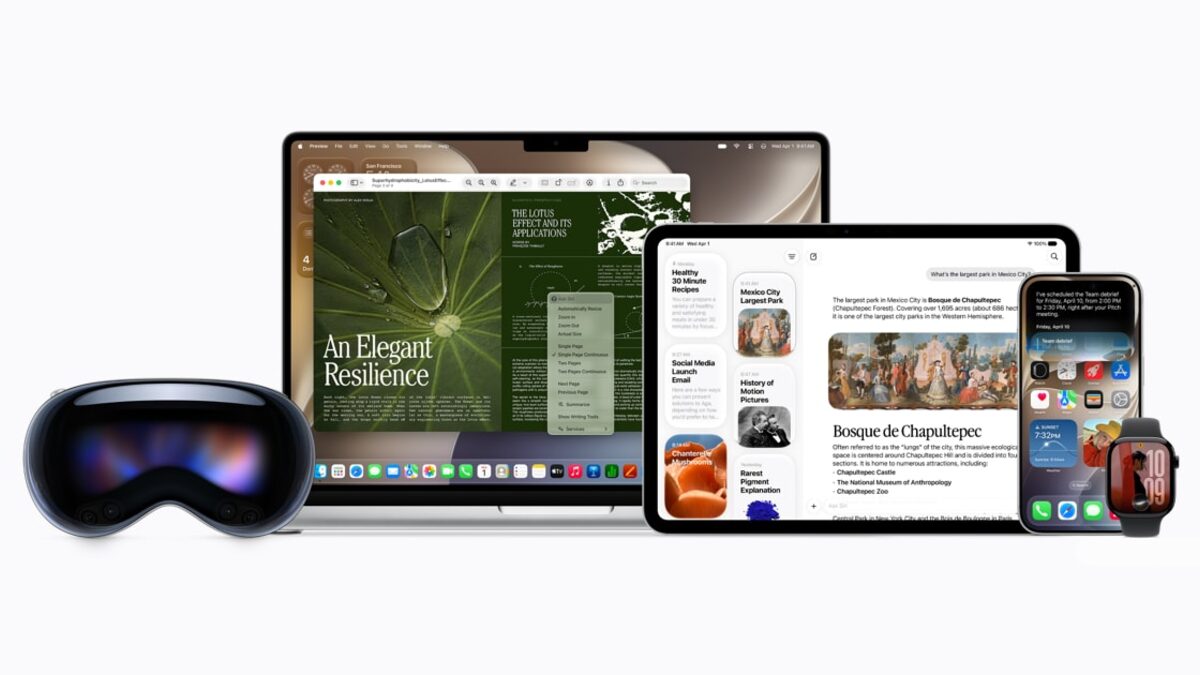
Three capabilities do the heavy lifting. Personal context lets Siri search your messages and photos, even the files buried on your device, so “where’s Jeff’s new place” surfaces an address from a months-old text you never saved. On-screen awareness lets it answer “where is this exactly” about a photo you’re looking at without you describing it. Visual intelligence now lives inside the Camera app: tap the shutter, point at a meal for nutrition info, or point at a restaurant bill and split it with Apple Cash. Every scan and chat saves into a new standalone Siri app that syncs privately over iCloud, so you can start on iPhone and finish on Mac.
The demo that got the biggest reaction wasn’t a feature at all. It was the voice. Apple’s new expressive speech model read a goofy script about apricots (“Clear the fridge. No, clear all the fridges”) with real intonation, and a slider lets you tune pace and expressivity until it sounds right to you. Paired with a large jump in dictation accuracy, that’s arguably more useful day to day than any single agent trick. Most people don’t want Siri to write for them. They want it to hear them correctly.
The smartest single idea sits in Shortcuts. You can now describe an automation in plain language (“when I’m leaving work, message my partner my ETA”) and Siri assembles the steps, wiring up your location, Maps, and Messages on its own. Shortcuts has always been the iPhone’s most powerful feature that almost nobody touched, because building one felt like programming. Describing one in a sentence changes who it’s for.
The catches Apple put in the footnotes
Now the fine print, and there’s a lot of it. The headline limitation is hardware. The most capable on-device model, the one driving the new expressive voice and the upgraded dictation, only runs on the iPhone Air and the iPhone 17 Pro, the two phones with 12GB of RAM. Not the base iPhone 17. Not the iPhone 16, the phone Apple marketed two years ago as “built for Apple Intelligence.” Every other Apple Intelligence iPhone still gets Siri AI and its conversational smarts, just without the best voice and dictation.
| Tier | Devices | What you get |
|---|---|---|
| Full Siri AI | iPhone Air, iPhone 17 Pro (12GB RAM) | Conversational Siri, expressive voice, upgraded dictation |
| Standard Siri AI | iPhone 15 Pro through iPhone 17, recent iPad and Mac | Conversational Siri, personal context, visual intelligence |
| iOS 27 only | iPhone 11 and newer | The OS, faster performance, no new Siri |
There’s a real upside hiding in that bottom row. iOS 27 runs all the way back to the iPhone 11, Apple’s widest support list ever, thanks to scheduler work that brought a more efficient CPU manager to older chips. So the old phones get faster even if they don’t get the assistant.
Geography is the next wall. Siri AI “will not be available initially in the EU on iOS and iPad OS,” with Apple saying it’s still working out a path that fits the bloc’s privacy and competition rules. In China, Siri AI and the rest of the new Apple Intelligence features are held back pending regulatory clearance. Between them, that’s a large slice of Apple’s user base waiting indefinitely.
Then there’s the money question Apple soft-pedaled. Server-powered features like image generation and the new photo edits carry daily usage limits, and Apple says heavier use comes “with most iCloud Plus subscription plans.” It was one sentence on a busy slide, and it papers over the thing people most want to know: what’s free, what’s metered, and what nudges you toward a subscription. Timing is the last asterisk. Developers can try the new Siri now, a public beta lands next month, and Siri AI reaches everyone else in beta this fall, English first, with more languages “quickly” after.
Everything else Apple shipped
The Siri news swallowed the keynote, but the supporting cast matters. Apple spent the opening stretch on plumbing rather than features: apps launch up to 30% faster, new photos appear in your library up to 70% faster, AirDrop transfers up to 80% faster, and Spotlight, Photos, and Mail sit on a rebuilt search index. After two years of complaints about Liquid Glass readability, Apple added a slider that runs from ultra-clear to fully tinted, handed the argument to users, and brought color back to Mac sidebar icons. The new macOS is called Golden Gate.
The middle third went to child safety, an entire act of the show. New child accounts gate what kids can see, who they can talk to, and when, with “ask to browse” extending parental approval from apps to individual websites, and communication safety now blurring gore and violence on top of nudity. The features look genuinely useful and arrive as governments lean on platforms over kids’ safety. The cynical read, which several reviewers reached for, is that the best parental controls also produce the youngest possible iPhone owners.
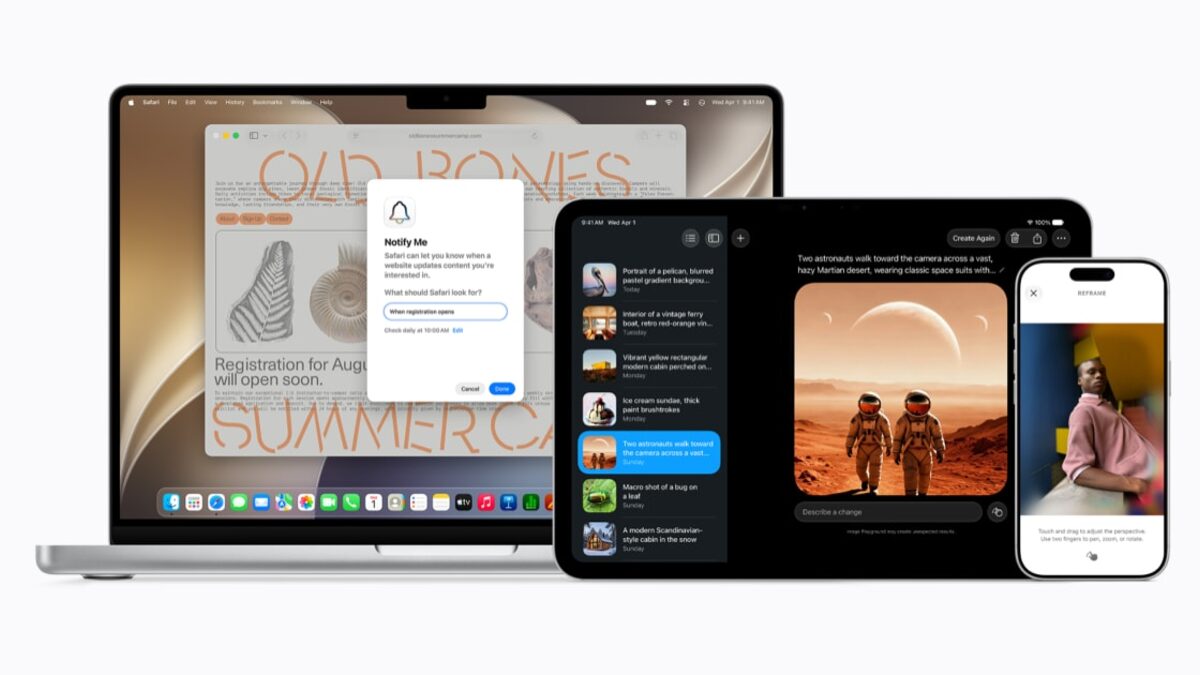
On the creative side, Image Playground gained a real generative model that can do photorealistic output, and Photos picked up three AI edits: a stronger cleanup tool, an extend tool that grows an image past its frame, and spatial reframing, which lets you drag to change the camera angle after the shot and fills the gaps with generated content. It’s an impressive trick and a slightly uncomfortable one, because it quietly bends what a photo even is. Safari can now group your tabs by topic, watch a page and ping you when it changes, and build a custom extension from a plain-language description. The Passwords app can log into a site, change a weak password, and save the new one for you. Home summarizes camera clips into plain English. And a throwaway developer slide about apps that resize across “multiple aspect ratios” did nothing to quiet the foldable-iPhone chatter.
What’s actually new here
The recap is easy. The synthesis is the part worth your time, and it comes down to four shifts.
The first is the dependency itself. Apple’s whole brand is the seamless marriage of its own hardware and its own software, and the assistant at the center of that pitch now runs on a competitor’s model that Apple pays a reported $1 billion a year to license. Apple couldn’t build a frontier model in time, so it rented one and wrapped it in privacy engineering. That’s a pragmatic, even smart move. It’s also an admission, and Apple knew it, which is why the Google credit got ten seconds and the privacy framing got ten minutes.
The second is how conservative the product is next to the model under it. Gemini can do aggressive agentic stunts. Google demoed an assistant buying concert tickets from a photo of a poster at its own developer conference weeks ago. Apple’s Siri stops one step short on purpose: it’ll find the lottery, draft the reminder, add the calendar event, and hand the decision back to you. It’ll find the lottery and draft the reminder, then hand the decision back to you. After a $250 million lesson in overpromising, “it does the safe thing reliably” is the correct product call, even if it reads as timid.
The third is lock-in, dressed as convenience. A Siri that indexes everything on your device is most useful precisely when you live entirely inside Apple’s apps, and the agentic password tool quietly makes Apple’s Passwords the only thing that knows your new logins. The new macOS being named Golden Gate is almost too on the nose. When the walls of the garden are golden gates, you stop noticing they’re walls. The real test is how gracefully Siri handles a life lived in Gmail, WhatsApp, and Spotify, and that’s exactly what Apple didn’t demo.
The fourth is timing of a different kind. This was Tim Cook’s last WWDC as CEO before John Ternus takes over on September 1, and Cook closed with a personal note that “the best is still ahead.” Whether that’s true now depends on a model with someone else’s name on it.
Practical takeaways
None of this is live yet. The developer beta opened on June 8, a public beta follows next month, and the wide release lands this fall, so treat the list below as planning notes for the 2026 rollout rather than buy-it-today advice.
- If you want the full new Siri, including the expressive voice and better dictation, you need an iPhone Air or iPhone 17 Pro. A base iPhone 17 or an iPhone 16 gets the conversational assistant but not the top tier.
- Don’t upgrade hardware on day one. Siri AI arrives in beta this fall, English first, and Apple’s last Siri promise slipped by more than a year. Wait for real-world reviews of reliability, not the keynote demos.
- If you’re in the EU or China, assume you won’t have Siri AI at launch and plan around third-party apps like Gemini, ChatGPT, or Claude in the meantime.
- Older iPhone owners still win: iOS 27 reaches the iPhone 11 and makes it faster, even without the new assistant.
- Watch your iCloud usage. Image generation and the new photo edits are metered, with more headroom tied to paid iCloud Plus tiers.
Open questions
The biggest unknown is reliability under load. A scripted demo proves a feature can work once; it says nothing about how Siri behaves across roughly 1.5 billion devices when the queries are messy and the network is bad. The second is the third-party story. Apple’s answer to “can Siri use my non-Apple apps” was a soft “if the developer adopts App Intents and you ask for it by name,” which is not the same as it just working. The third is the EU timeline, which Apple left genuinely open. And the fourth is the one Apple will never answer on stage: what happens to the privacy pitch, and the $1 billion bill, if Google ever decides the terms should change. The demo landed. The dependency is the story.
Share this article
Quick reference
Sources
- Introducing the next generation of Apple Intelligence and Siri (WWDC 2026 keynote) — Apple
- WWDC 2026: Everything announced on Siri AI, iOS 27, Apple Intelligence and more — TechCrunch
- Apple is paying Google $1bn to upgrade Siri with Gemini — Android Authority
- Mark Gurman: Apple to use a custom 1.2-trillion-parameter Google Gemini model for Siri — Bloomberg / Mark Gurman
- Apple promised a smarter Siri, but a lawsuit says it didn't deliver, and you can get up to $95 back — Fortune
- Siri Lawsuit: Apple Agrees to Pay Owners of These iPhone Models — MacRumors
- WWDC 2026: Apple makes its big Siri AI reveal, changes Liquid Glass and more — CNBC