Local opposition stalled $130 billion of data centers, and New York froze permits statewide
Gallup puts local opposition at 71%. Hochul's order pauses 50 MW-plus permits for a year, and PJM's last auction billed data centers $6.3 billion.
New York stopped issuing permits for new hyperscale data centers on July 14. Governor Kathy Hochul’s Executive Order 62 pauses state approvals for up to a year on anything drawing 50 megawatts or more. Her stated reason was electricity bills.
That order is the loudest signal yet in a fight that has been running county by county for two years. Gallup found in March that 71% of Americans oppose an AI data center in their local area, and Data Center Watch counted 75 projects blocked or delayed in the first three months of 2026, worth roughly $130 billion in planned construction, as Brookings summarized. The opposition doesn’t sort neatly by party, which is rare for anything touching land use and energy. For anyone building or renting AI capacity, that has stopped being a public-relations problem and become a siting constraint.
What the objections actually are
Gallup’s survey of 1,000 adults, fielded March 2 to 18, put strong opposition at 48% against 25% in favor. Asked to explain themselves, half of opponents pointed at resource use, split evenly between water and energy at 18% each. Another 20% named quality-of-life effects: noise, construction traffic, and what a windowless industrial block does to a two-lane road. Opposition to a local data center ran well ahead of opposition to a local nuclear plant, 71% to 53%.
The tax-break argument is where support has collapsed fastest, and Virginia is the clearest record of it because the state has the longest history. Washington Post-Schar School polling found 61% of Virginians backed tax breaks for data centers that create 1,000 or more jobs in 2023. By 2026 that was 37%, with 56% opposed. A separate Commonwealth Poll found 69% opposed to the breaks and 78% in favor of additional fees on data center electricity, per Cardinal News, and Republicans opposed the breaks at 68.6% against 73.1% of Democrats. Both parties, same answer.
Permanent headcount is part of why. Google’s Botetourt County campus is pitched at about 300 jobs, and Stack Infrastructure promised more than 2,500 in Pittsylvania County. Against a multibillion-dollar capital cost, residents increasingly read the abatement as the number that matters, and they’re not wrong to.
The industry’s counterargument is not empty. Dan Diorio, vice president of state policy at the Data Center Coalition, told CNN that a statewide ban would “send a signal that the state is closed for business” and would “discourage further investment, both from the data center industry and other advanced industries that depend on predictability.” The trade group says the sector delivers “significant benefits to states and local communities” in jobs, investment and tax revenue. On the tax point it has the stronger case: a multibillion-dollar building on a rural county’s roll changes that county’s budget in a way nothing else on offer does.
Why a new load moves rates
The mechanism gets flattened in most coverage, so it’s worth stating plainly. A large data center’s effect on residential bills comes less from the kilowatt-hours it burns than from the capacity it reserves and the transmission it triggers, and those costs are spread across the whole customer class. AEP Ohio is a clean illustration. Central Ohio data center load went from 100 MW in 2020 to about 600 MW in 2024, and the utility now holds requests from more than 50 customers at 90-plus sites totaling over 30,000 MW, POWER Magazine reported. Almost none of that will get built. All of it has to be studied in the interconnection queue.
Then there is the capacity auction, which is where the number gets ugly. PJM Interconnection billed $16.4 billion for the 2027/2028 delivery year, and market monitor Joseph Bowring attributed $6.3 billion of that, 38%, to data centers; across the last four base auctions his office puts the figure at $29.4 billion of $63.6 billion, or 46%, according to Utility Dive. “PJM is continuing to act like it’s business as usual,” Bowring said, and his proposed remedy is blunt: “There’s only one way to do what hyperscalers agree is the right thing to do, and that is to run a separate auction.” PJM projects peak demand growing 32 gigawatts between 2024 and 2030, with all but 2 GW of that from data centers, and Canary Media notes some PJM customers face bill increases of 1.5% to 5% in the 12 months from June 2026.
Regulators have started writing the load its own rules. Ohio’s utilities commission approved a tariff that puts new data centers above 25 MW on contracts of up to 12 years with a four-year ramp, requires them to pay for at least 85% of subscribed capacity whether they use it or not, and adds exit fees and financial assurances. PUCO chair Jenifer French called it “a well-balanced package that safeguards non-data center customers on an industrial and residential level.” Whether that’s true in practice is contested. In the April 2 rate case the commission granted AEP Ohio an $11 million distribution increase against the $97 million it asked for, and while the utility projects a small monthly decrease, the Ohio Environmental Council told WOSU the average residential bill could climb $4.38 a month by year end and $10.28 by 2028.
Zoning votes and gas plants
Four different instruments are doing the work, at four levels of government. The megawatt thresholds matter more than the rhetoric, because they decide which projects get caught and which slide underneath.
| Where | Instrument | Threshold | What happened |
|---|---|---|---|
| New York | Executive Order 62 | 50 MW or more | Permit pause of up to one year from July 14 |
| New York legislature | Responsible Data Center Development Act | 20 MW or more | Passed 44 to 16 in the Senate, 102 to 39 in the Assembly, still unsigned |
| Ohio, AEP territory | PUCO data center tariff | 25 MW or more | 85% minimum take, up to 12 years, exit fees |
| Grimes County, Texas | Tax abatement and reinvestment zone | Not applicable | Approved in June, one commissioner voted no |
The New York split is instructive. Lawmakers passed the bill on June 4 at a 20 MW trigger, DLA Piper’s summary notes, and Hochul then acted by executive order at 50 MW instead of signing it. Elsewhere the venue is smaller and blunter. Voters in Monterey Park, California approved a ballot measure banning data centers outright, and Grist counts more than 800 local groups organizing on the issue across 49 states.
Texas shows the fight in miniature, and it isn’t only about servers. Grimes County commissioners voted in June to grant SpaceX a tax abatement and reinvestment zone for Terafab, the chip plant whose first phase carries a $55 billion price tag and could reach $119 billion. Commissioner David Tullos of Precinct 2 voted against it, saying he had not been “afforded that opportunity” to decide on adequate information. SpaceX’s John Federspiel told the court the project “presents significant opportunities in skilled trades, construction employment, suppliers and contractors” and projected 1,800 local hires, per Business Insider. Marie Egyed of Grimes County Citizens for Responsible Development called the process “disrespectful to the people living in that zone and in this entire county.”
Hyperscalers can’t fund this buildout alone, so the fossil-fuel majors have walked in with the power. Chevron signed a 20-year agreement with Microsoft for Project Kilby, a 1.58 GW gas-fired power station near Pecos, Texas, announced June 22, inside a West Texas complex it plans at 2.5 GW and can scale to 5 GW. The Pecos-Barstow-Toyah school board approved more than $227 million of tax savings over 10 years for the associated plant under Texas’ JETI Act, Grist found. Williams makes the ratepayer argument explicitly: behind-the-meter power “can help communities add the electricity large customers need without shifting those grid upgrade costs onto families,” says Kilian Bryce, its director of business development for power innovation, on the company’s site. That claim is defensible on its own terms. It also moves the project outside the rate case and the interconnection queue, which are the two proceedings where residents get standing to object.
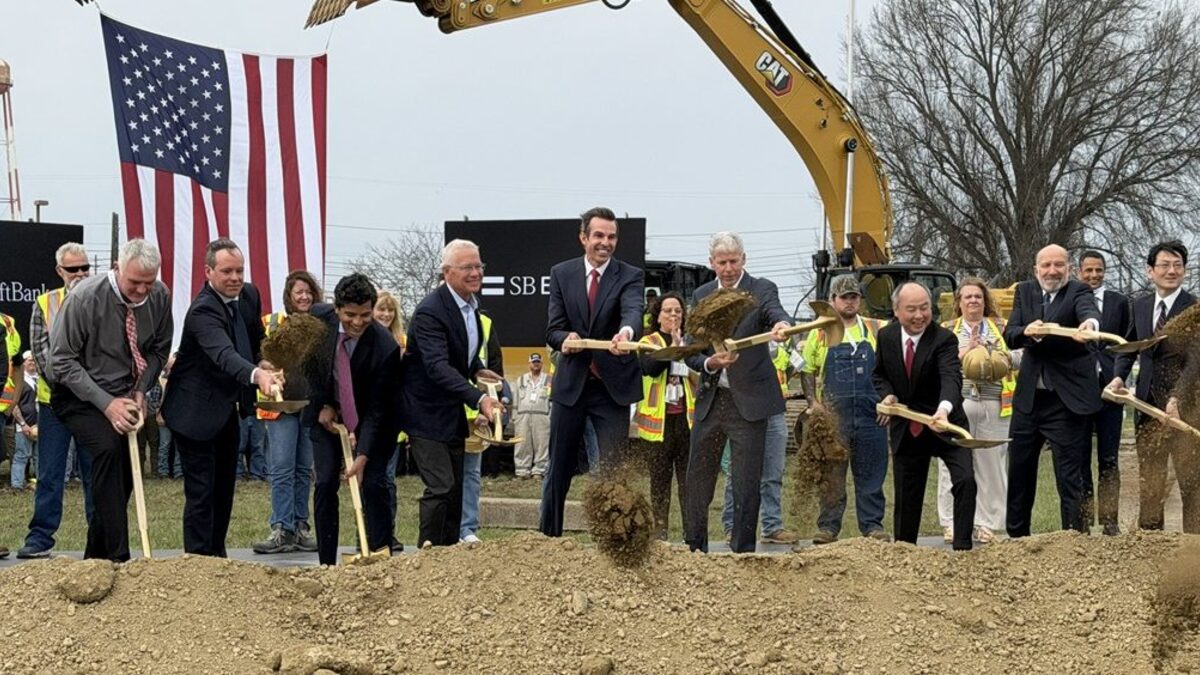
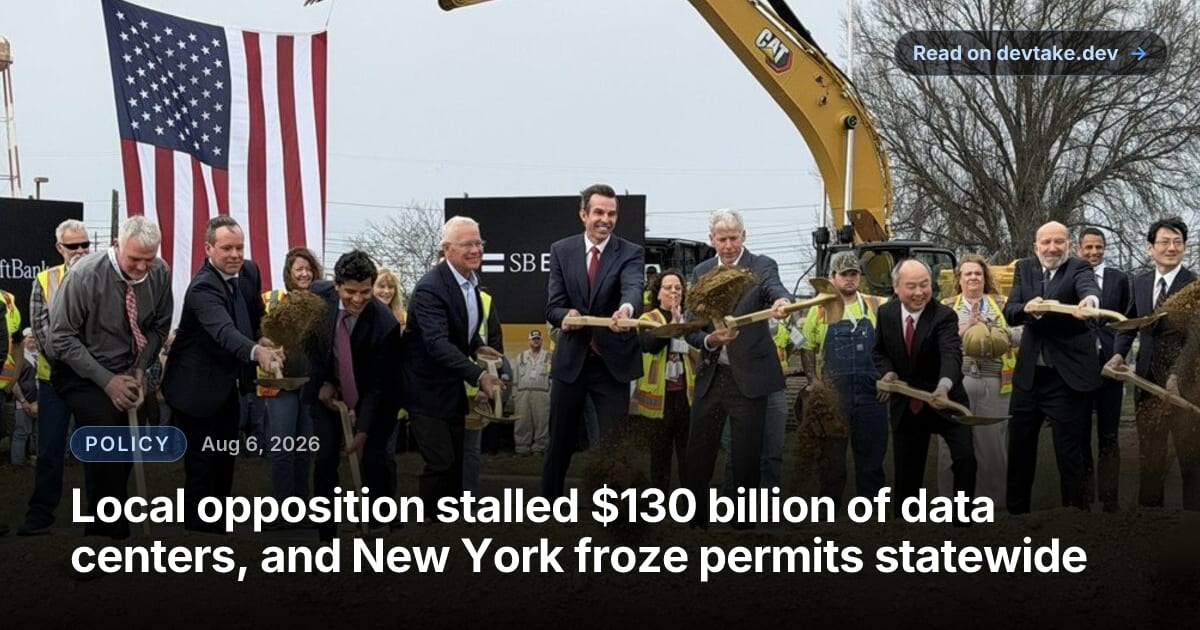
Federal land is the other bypass. SB Energy broke ground on March 20 at the former Portsmouth Gaseous Diffusion Plant in Piketon, Ohio, a site planned at 10 GW with a $33 billion gas plant, 35,000 peak construction workers and 2,500 permanent staff, WOUB reported. SoftBank chairman Masayoshi Son addressed the bill question head on: “We will protect the electricity bill. We will not take electricity away from the grid.” Two months later Politico reported that SoftBank donated $50 million to Trump’s presidential library, and in July Senators Elizabeth Warren and Richard Blumenthal and Representative Melanie Stansbury asked the company to explain the circumstances, the Washington Post reported. Those facts sit next to each other in the public record. Nothing published so far connects them, and the senators’ inquiry hasn’t closed.
What this means for you
If you are modeling where AI capacity lands over the next 24 months, the constraint is no longer chip supply alone. Nvidia’s position on accelerators sets the price of the rack. County commissions and state permit offices now set whether the rack has a building. The practical read: capacity is migrating toward gas basins with behind-the-meter generation, toward federal sites like Piketon, and away from jurisdictions with a live moratorium, which means latency maps and data-residency plans drawn in 2025 are already stale.
Two things are worth watching if this is your beat. First, whether the 85% minimum-take tariff spreads beyond Ohio, because that single term decides who eats the cost of a project that gets canceled. Second, whether firm clean supply arrives fast enough to change the politics at all, since designs like Realta’s direct-electricity fusion are among the few pitches that answer the bill objection and the emissions objection at once. Federal preemption is the wildcard, and the administration’s narrowed AI executive order left state siting law untouched. Until that changes, a zoning hearing in a county of 30,000 people is a real gate on the buildout.
Share this article
Quick reference
Sources
- Americans Oppose AI Data Centers in Their Area — Gallup
- First Statewide Moratorium on New Hyperscale Data Centers Launched by Governor Kathy Hochul — Office of the Governor of New York
- New York State Legislature passes first-in-the-nation data center moratorium — DLA Piper
- Data centers drove $6.3B in PJM capacity auction costs: market monitor — Utility Dive
- PJM's capacity costs hit record as grid falls short on supply — Canary Media
- Regulator Approves AEP Ohio's Landmark Data Center Tariff — POWER Magazine
- State utilities commission approves AEP Ohio rate changes — WOSU Public Media
- America's data center backlash is bipartisan. Can it stay that way? — Grist
- Data center backlash signals a fight over AI power — Brookings
- Political earthquake: Conservatives are turning against data centers — Cardinal News
- Data centers are spreading around the country. Now, data-center bans are, too — CNN
- AI backlash has come for Elon Musk's massive Terafab chip factory in Texas — Business Insider
- Chevron Signs Behind-the-Meter Power Pact with Microsoft for West Texas Data Center — Industrial Info Resources
- Chevron wants a school district tax break for a data center power plant — Grist
- Behind-the-meter power offsets costs of new demand — Williams
- Officials break ground for what could be the nation's largest data center in Pike County — WOUB Public Media
- Democrats ask SoftBank to explain Trump library donation — The Washington Post
Frequently Asked
- Do data centers raise my power bill?
- In some regions, yes, through capacity and transmission charges rather than energy use. PJM's market monitor attributed $6.3 billion of the last auction's $16.4 billion in charges to data centers, and those charges reach retail bills.
- How much electricity does one data center actually use?
- New York's moratorium starts at 50 megawatts, roughly a small town. Hyperscale campuses are quoted in gigawatts now: SoftBank's Piketon site is planned at 10 GW at full buildout.
- Can a county legally say no to a data center?
- Usually yes, through zoning, rezoning denials and refusing tax abatements, because siting is a local land-use decision. What a county cannot do is set electricity rates, which is why the bill fight moves to state regulators.
- Does behind-the-meter power fix the ratepayer problem?
- Williams argues it avoids shifting grid upgrade costs onto households. Critics note it also removes the project from the utility rate case and the interconnection queue, so there is no state proceeding where residents can intervene.