'Physical buttons are better': Mercedes is retrofitting its steering wheels across the lineup.
Mercedes software chief Magnus Östberg confirms physical buttons return on the new GLC and CLA, citing software-defined vehicle telemetry from CLA drivers.
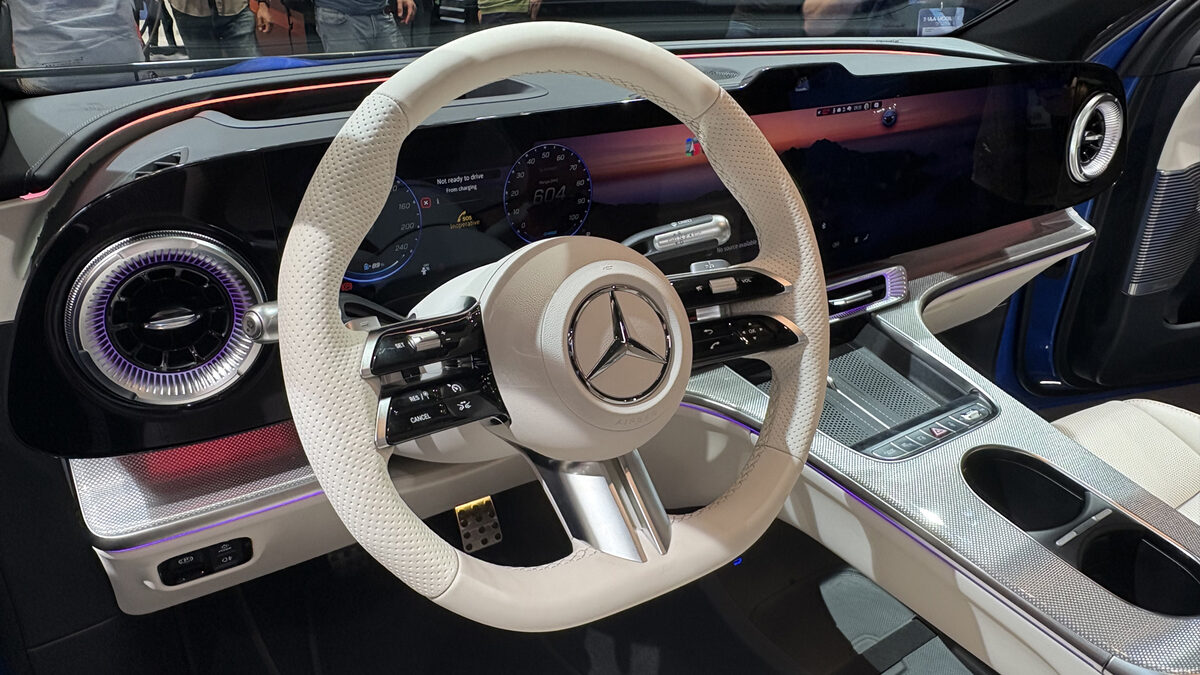
Mercedes-Benz is retrofitting physical controls across its lineup, starting on the steering wheels of the new CLA and the 2026 GLC EV. The reversal lands on the same vehicles as the company’s largest-ever in-cabin display, the 39.1-inch curved MBUX Hyperscreen on the GLC. Magnus Östberg, the company’s software chief, told the press at the Munich motor show: “The data shows us physical buttons are better.”
That quote is the headline because the line is doing two things at once. It’s a public admission that the touch-everything era of luxury-car UX overshot. And it’s an explicit framing of the decision as data-driven, not customer-vibes-driven, because the data Östberg means is software-defined vehicle telemetry from real CLA drivers.
What’s actually returning
The new steering wheel ditches the haptic-pad buttons that drove much of the Mercedes interior backlash and brings back three families of physical control: rockers, rollers, and discrete buttons. Autocar reports the design rolls out first on the CLA saloon (already shipping) and the 2026 GLC and CLA Shooting Brake EVs, then becomes standard across the rest of the model range.
The huge dashboard screens stay. The MBUX Hyperscreen on the GLC isn’t getting smaller; it just stops being the only way to do things. Center-stack touchscreens are still in. The reversal is specifically on tactile primary controls (volume, climate, drive mode, ADAS) that should never have moved off physical hardware in the first place.
Mercedes design chief Gordon Wagener told Autocar there’s a ceiling on screen size in cars: drivers don’t want a TV in front of them, and a 13-15-inch display is the practical limit. That’s a striking thing to hear from the company that just shipped a 39-inch one.
The first generation of the CLA, which Mercedes calls its “first software-defined vehicle,” is the bridge model that produced the data. The 2026 GLC is the second.
Why the data argument matters
Östberg’s specific phrasing, “the data shows us physical buttons are better”, reframes a debate that’s been running for five years. The earlier round, the JD Power and Consumer Reports backlash against touch-only interiors that started around 2020, was based on customer survey ratings. Automakers nodded sympathetically and kept shipping touch-only.
The CLA telemetry is harder to wave off because Mercedes can see what drivers actually do, not what they say in surveys. Östberg also noted voice command usage in CLA drivers “tripled” since the SDV launch. Voice tripling and physical buttons returning are not contradictory: both replace the act of looking down to find a tap target while moving. Touch is what gets squeezed.
This is the pattern other automakers have set: Volkswagen committed to bringing back buttons in 2022 and is still working through it. Hyundai walked back touch-only HVAC in 2023. Porsche’s Taycan refresh kept screens but added physical climate controls. The new Mercedes commitment is louder because Mercedes was the brand most associated with the giant-screen aesthetic at the top of the market.
Two pieces of context worth holding onto. Mercedes is also varying the wheel design by region: European markets get more buttons, Asian markets get more touch and voice. The “physical buttons are better” claim is a global average; the rollout isn’t uniform. And the fix is on the steering wheel only, not the doors or center console (yet).
What this means for you
If you’re shopping a luxury EV or hybrid in 2026 and you walked away from a Mercedes test drive in 2023 because the steering-wheel haptic pads felt impossible to use without taking your eyes off the road, the new CLA and the 2026 GLC are worth a second test drive. The steering wheel is genuinely different.
If you already own a CLA, Östberg’s “rollout” framing in Autocar’s reporting suggests current-generation cars get a redesigned wheel through a service-center retrofit rather than a software update. That’s not confirmed by Mercedes as a free swap, so call your dealer before assuming. The cost question is the one to ask.
If you don’t drive a Mercedes but you care about the UX-in-cars debate, the load-bearing detail in this story is the data argument. Three to five years of touchscreen-only luxury interiors generated the telemetry that’s now killing the design pattern. The rest of the industry will follow on the same evidence base. Watch BMW’s next refresh and Audi’s next platform reveal. The buttons are coming back across the segment.
Share this article
Sources
- Mercedes to add proper buttons back to its interiors after launching its biggest screen ever — Autocar
- Mercedes-Benz Is Bringing Back Buttons: 'Physical Buttons Are Better' — Motor1
- Mercedes-Benz commits to bringing back physical buttons — Drive.com.au
- Mercedes-Benz hits the brakes on touchscreens, signaling return to physical buttons — TechSpot
- Buttons Are Coming Back to Cars but They Will Take Time — Kelley Blue Book